
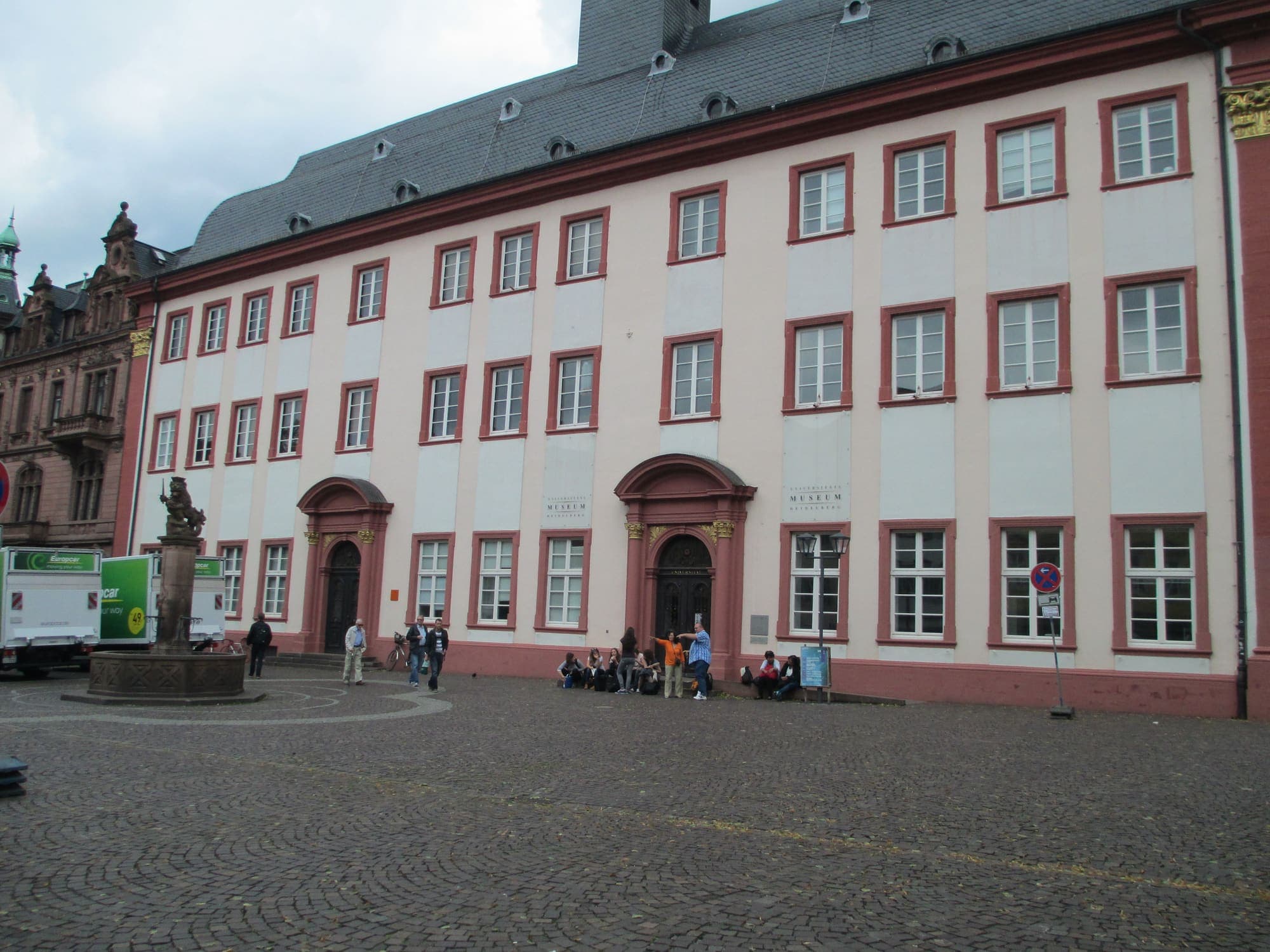
Heidelberg University (Ruprecht-Karls-Universität Heidelberg)
Quick Snapshot & Key Statistics
| Official Name | Ruprecht-Karls-Universität Heidelberg (Heidelberg University) |
| Institution Type | Public Comprehensive Research University / University of Excellence (Exzellenzuniversität) |
| Established | 1386 (Germany's oldest university; third oldest in the Holy Roman Empire) |
| Total Enrollment | ~29,000+ Students (~20% International Students from 130+ countries) |
| Academic Faculties | 12 Faculties | Over 160 Degree Programs |
| Nobel Laureates | Associated with 57 Nobel Laureates (e.g., Max Born, Otto Meyerhof, Robert Bunsen) |
| Primary Location | Heidelberg, Baden-Württemberg, Germany |
| Global Rankings | Ranked Top 50 Worldwide (THE) & Top 3 in Germany |
| Tuition Fees (Non-EU) | €1,500 per semester (~€3,000 / year) |
| Tuition Fees (EU/EEA) | €0 / year (Tuition-Free for EU/EEA citizens) |
| Semester Fee | ~€171 to €200 per semester |
About Heidelberg University
Founded in 1386 under the instruction of Pope Urban VI, Heidelberg University (Ruprecht-Karls-Universität Heidelberg) is Germany's oldest university and one of Europe's most prestigious research institutions. Designated as an official University of Excellence under Germany's national Excellence Strategy, Heidelberg is internationally celebrated for pioneering research in Medicine, Life Sciences, Physics, Chemistry, Law, and the Humanities.
Heidelberg University is a founding member of the League of European Research Universities (LERU) and the Coimbra Group. The university maintains deep research alliances with premier non-university research institutes in the city, including the European Molecular Biology Laboratory (EMBL), four Max Planck Institutes (Nuclear Physics, Medical Research, Astronomy, and Comparative Public Law), and the German Cancer Research Centre (DKFZ).
Why Choose Heidelberg University?
- Germany's oldest university (established in 1386)
- Member of Germany's Universities of Excellence
- Globally recognised research university
- Strong international reputation
- World-class research facilities
- Collaborations with leading research institutes
- Affordable public education
- Excellent graduate employability
- Diverse international student community
- Wide range of English-taught Master's and doctoral programmes
Location & Campus Structure of Heidelberg University
Heidelberg University is located in Heidelberg, a world-famous city in the state of Baden-Württemberg in southwestern Germany, situated along the Neckar River near Frankfurt and Mannheim.
Unlike single-site universities, Heidelberg University is integrated into the city across three primary campus hubs:
- Altstadt Campus (Old Town - Universitätsplatz): Located in the medieval heart of Heidelberg, housing the historical assembly hall, University Library (Universitätsbibliothek), and faculties of Humanities, Theology, Philosophy, and Law.
- Im Neuenheimer Feld Campus: A high-tech science and medical complex north of the Neckar River, housing Medicine, Biosciences, Physics, Chemistry, Mathematics, Computer Science, and the University Hospital.
- Bergheim Campus: Located in a renovated historical hospital building near the main railway station, housing the Alfred Weber Institute for Economics, Sociology, and Political Science.
Popular Courses at Heidelberg University
Heidelberg University offers over 160 degree programs across 12 faculties:
Top English-Taught Master's Programs (International Favourites)
- M.Sc. Molecular Biosciences: World-class life science track with specialisations in Cancer Biology, Infectious Diseases, Neuroscience, and Developmental Biology.
- M.Sc. Physics: Advanced physics track focusing on Particle Physics, Cosmology, Quantum Dynamics, and Environmental Physics.
- M.Sc. Translational Medical Research: Specialised program bridging clinical medicine, biotechnology, and oncology research.
- M.Sc. Scientific Computing: Interdisciplinary track combining high-performance computing, mathematical modelling, and data analytics.
- M.Sc. Health & Society in South Asia (MAHASSA): Medical anthropology and global health track.
- M.A. American Studies: Hosted at the Heidelberg Centre for American Studies (HCA).
Top German-Taught Degree Programs
- Human Medicine & Dentistry (Staatsexamen): Highly competitive, world-renowned clinical training program ranked #1 in Germany.
- Law (Rechtswissenschaft - Staatsexamen): Ranked among the top law faculties in Europe.
- B.Sc. / M.Sc. Chemistry & Biochemistry: Cutting-edge research in molecular synthesis and chemical biology.
- B.A. / M.A. Psychology: Consistently features high national admission cutoffs (Numerus Clausus).
Language Requirements (English & German)
Language requirements depend on the medium of instruction for your specific program at Heidelberg University.
German Language Requirements (German-Taught Programs)
For degree programs taught in German (including all undergraduate Bachelor's and State Examination programs like Medicine and Law), non-native applicants must prove C1 CEFR German proficiency:
- DSH: DSH-2 or DSH-3 (DSH-2 is required for most programs; DSH-3 for Medicine).
- TestDaF: Minimum of 4x4 (TDN 4 in all 4 examination sections).
- telc: telc Deutsch C1 Hochschule.
- Goethe-Zertifikat: Goethe-Zertifikat C2.
English Language Requirements (English-Taught Programs)
Heidelberg University offers a growing suite of international Master's degree programs taught 100% in English. Applicants must submit proof of B2 or C1 CEFR English proficiency:
| IELTS Academic | Overall 6.5 or 7.0 (program-dependent) |
| TOEFL iBT | 90 to 100 points or higher |
| Cambridge English | C1 Advanced (CAE) or C2 Proficiency (CPE) |
| PTE Academic | 65 points or higher |
Tuition Fees
Bachelor's Programmes
- EU/EEA Students: No tuition fees
- Non-EU Students: €1,500 per semester (for most degree programmes)
- Semester contribution: Approximately €170–€200 per semester
Master's Programmes
- Consecutive Master's — EU/EEA Students: No tuition fees
- Consecutive Master's — Non-EU Students: €1,500 per semester (for most programmes)
- Semester contribution: Approximately €170–€200 per semester
- Exemptions: Certain programmes and categories of students may be exempt from tuition fees under Baden-Württemberg regulations.
Mandatory Administrative & Living Costs in Heidelberg
- Semester Fee: ~€171–€200 per semester.
- Blocked Account (Sperrkonto) for Visa: Non-EU international students must deposit €11,904 per year into an official Blocked Account to draw €992 per month for living expenses.
- Living Expenses in Heidelberg: Monthly living costs average between €900 and €1,200 per month (covering student dorm/WG rent: €350–€550, statutory health insurance: ~€140/month, food, and daily expenses).
Research & Industry Partnerships
Heidelberg University collaborates with leading organisations and institutions, including:
- German Cancer Research Centre (DKFZ)
- European Molecular Biology Laboratory (EMBL)
- Max Planck Society
- Helmholtz Association
- SAP
- BASF
- Roche
- Heidelberg University Hospital
- BioRN Life Science Cluster
- European Bioinformatics Institute (EMBL-EBI)
These collaborations provide students with internships, cutting-edge research opportunities, innovation projects, and excellent graduate employment prospects.
Let's plan your path to studying at Heidelberg University
From matching your profile to the right faculty to preparing a compelling application, our counsellors guide every step of your journey.
Frequently Asked Questions (FAQs)
Heidelberg University has two separate medical faculties: Medical Faculty Heidelberg, located at Neuenheimer Feld, focusing heavily on oncology, immunology, and molecular biology and Medical Faculty Mannheim, located in Mannheim, focusing on translational medical research, medical technology, and clinical systems engineering.
Yes. Under the state laws of Baden-Württemberg, Heidelberg University charges international students from non-EU/EEA countries a tuition fee of €1,500 per semester (~€3,000 per year). Students from EU/EEA countries study tuition-free.
Heidelberg University is consistently ranked among the Top 3 universities in Germany and ranks in the Top 50 globally according to Times Higher Education (THE) and Academic Ranking of World Universities (ARWU).
Heidelberg is an integrated university town with three main campus hubs: the Altstadt Campus in the historic Old Town (Humanities and Law), Im Neuenheimer Feld (Medicine, Natural Sciences, and Life Sciences), and the Bergheim Campus (Economics and Social Sciences).
Yes. While undergraduate Bachelor's degrees are almost exclusively taught in German, Heidelberg University offers numerous fully English-taught Master's degrees, particularly in Molecular Biosciences, Physics, Scientific Computing, and Translational Medical Research.
Founded in 1386, the Universitätsbibliothek Heidelberg is Germany's oldest university library. It houses over 3.2 million physical books, historic manuscripts (such as the Codex Manesse), and modern digital learning workspaces across the Old Town and Neuenheimer Feld sites.
heiCO (Heidelberg Campus Online) is the central campus management system used by students to apply for programs, register for modules, sign up for semester examinations, download enrollment certificates, and check academic transcripts.
International applicants holding foreign school-leaving or university credentials apply through the uni-assist portal or directly via Heidelberg University's online portal (heiCO), depending on the chosen program.
Heidelberg operates one of Europe's top clinical and research hospitals (Universitätsklinikum Heidelberg) and collaborates directly with the German Cancer Research Centre (DKFZ) and EMBL, making it a global hub for medical research, molecular biology, and oncology.
Yes. Non-EU international students enrolled at Heidelberg University are legally permitted to work up to 140 full days or 280 half days per calendar year. Student workers (Werkstudenten) in Heidelberg typically earn €14 to €20 per hour.
No. Doctoral candidates at Heidelberg University are exempt from the €1,500 per semester non-EU tuition fee and only pay the standard semester contribution.
Yes. Heidelberg University, the German Academic Exchange Service (DAAD), and other organisations offer scholarships and financial support for eligible students.
For the Winter Semester (October start), applications for restricted programs generally close on July 15. For the Summer Semester (April start), applications close on January 15.
Heidelberg University is an excellent choice for students seeking a globally respected degree, outstanding research opportunities, affordable public education, and strong career prospects in Germany and around the world. Its combination of historic academic excellence, modern research facilities, and international outlook makes it one of the best destinations for higher education in Europe.
Explore Other Universities in Germany
Photo credits: Alte Universität, Heidelberg by Avi1111 dr. avishai teicher, CC BY-SA 4.0; Mannheim Palace, University of Mannheim by Stefanie Eichler, CC BY-SA 3.0. Via Wikimedia Commons. All image credits
