
Karlsruhe Institute of Technology (KIT)
Quick Snapshot & Key Statistics
| Official Name | Karlsruhe Institute of Technology (Karlsruher Institut für Technologie) |
| Institution Type | Public Research University & National Research Centre / University of Excellence (Exzellenzuniversität) |
| Established | 1825 (Polytechnic School) | Merger in 2009 (University of Karlsruhe + Forschungszentrum Karlsruhe) |
| Motto | The Research University in the Helmholtz Association |
| Total Enrollment | ~22,000–25,000+ Students (~5,300+ International Students from 120+ nations) |
| Academic Faculties | 11 Divisions/Faculties | Over 100 Degree Programs |
| Institutional Affiliations | TU9 Alliance, Helmholtz Association, CESAER, EPICUR Alliance |
| Main Campus Hubs | Campus South (City Centre / University Campus) & Campus North (National Research Centre) |
| Global Rankings | Ranked Top 100–110 Worldwide (QS) | Top 5 in Germany for Engineering & Computer Science |
| Tuition Fees (Non-EU) | €1,500 per semester (~€3,000 / year under Baden-Württemberg state law) |
| Tuition Fees (EU/EEA) | €0 / year (Tuition-Free for EU/EEA citizens) |
| Semester Fee | ~€180–€184 per semester (Administrative + Studierendenwerk fee) |
About Karlsruhe Institute of Technology (KIT)
Founded in 1825 as a polytechnic school model inspired by Paris's École Polytechnique, the Karlsruhe Institute of Technology (KIT) (Karlsruher Institut für Technologie) is Germany's oldest technical university and a premier centrepiece of European scientific infrastructure. Officially designated as an elite University of Excellence under Germany's national Excellence Strategy, KIT holds a unique status as both a public university and a national research laboratory of the Helmholtz Association.
Located in Karlsruhe—the tech hub of Baden-Württemberg and seat of Germany's Federal Constitutional Court—KIT bridges fundamental scientific discovery with industrial execution. Through its specialised schools such as the Carl Benz School of Engineering and the HECTOR School of Engineering & Management, KIT maintains direct research ties with global technology powerhouses, including Bosch, Daimler/Mercedes-Benz, SAP, Siemens, and Porsche.
Why Choose Karlsruhe Institute of Technology (KIT)?
- One of Germany's top engineering and research universities
- Member of Germany's Universities of Excellence
- Strong focus on innovation and technology
- World-class research laboratories
- Excellent industry collaborations
- Affordable public university education
- Wide range of English-taught Master's programmes
- Strong international community
- Outstanding graduate employability
- Excellent research and internship opportunities
Location & Campus Structure of KIT
KIT is situated in Karlsruhe, a major city in the state of Baden-Württemberg in southwestern Germany, located near the Rhine River and the French border (roughly 1 hour south of Frankfurt am Main).
KIT operates across three primary campus locations:
- Campus South (City Centre Campus): Located directly adjacent to Karlsruhe's central city park (Schlossgarten). Houses the core academic faculties, lecture halls, central library, and student administration.
- Campus North (Eggenstein-Leopoldshafen): Situated ~12 km north of the city centre. It houses large-scale national research laboratories, energy research facilities, particle accelerators, and nuclear safety research suites.
- Campus East (Rintheim): Dedicated to vehicle systems engineering, automotive research, and mobility test benches.
Popular Courses at KIT
KIT offers over 100 study programs across 11 academic divisions:
Top English-Taught Programs (International Favourites)
- B.Sc. Mechanical Engineering (Carl Benz School): Elite English-taught undergraduate engineering degree with specialised industry tracks in Automotive, Energy, and Production Management.
- M.Sc. Computer Science (Informatik): Advanced algorithmics, cybersecurity, robotics, parallel computing, and software engineering.
- M.Sc. Electrical Engineering and Information Technology: Focuses on microelectronics, power grids, photonics, and signal processing.
- M.Sc. Mechanical Engineering: World-renowned thermal engineering, automotive systems, and mechatronics curriculum.
- M.Sc. Optics and Photonics (KSOP): Offered via the Karlsruhe School of Optics & Photonics, covering laser tech, optical materials, and biophotonics.
- M.Sc. Energy Engineering and Management (HECTOR School): Executive Master's degree bridging smart grid engineering, renewable energy, and business economics.
Top German-Taught Degree Programs
- B.Sc. / M.Sc. Industrial Engineering and Management: Consistently ranked #1 in Germany for combining corporate economics with engineering mechanics.
- B.Sc. / M.Sc. Chemical and Process Engineering (Chemieingenieurwesen): Focuses on reaction kinetics, sustainable process design, and bioprocess engineering.
- B.Sc. / M.Sc. Mechatronics and Information Technology: Interdisciplinary hardware-software engineering curriculum.
- B.Sc. / M.Sc. Architecture: Combines structural design, urban planning, and computational building physics.
Language Requirements (English & German)
Language prerequisites depend on the medium of instruction for your chosen program at KIT.
German Language Requirements (German-Taught Programs)
For degree programs taught in German (including most standard Bachelor's and several Master's tracks), non-native applicants must demonstrate C1 CEFR German proficiency:
- DSH: DSH-2 or DSH-3.
- TestDaF: Minimum level of 4x4 (TDN 4 in all 4 examination sections).
- telc: telc Deutsch C1 Hochschule.
- Goethe-Zertifikat: Goethe-Zertifikat C2: GDS.
English Language Requirements (English-Taught Programs)
KIT offers an increasing number of international Master's degree programs and selected Bachelor's tracks taught 100% in English. Applicants must submit proof of B2 or C1 CEFR English proficiency:
| IELTS Academic | Overall 6.5 or higher |
| TOEFL iBT | 88 to 90 points or higher |
| Cambridge English | C1 Advanced (CAE) or C2 Proficiency (CPE) |
| PTE Academic | 60 to 65 points or higher |
Tuition Fees
Because KIT is located in the state of Baden-Württemberg, state legislation mandates tuition fees for international students from non-EU/EEA countries enrolled in standard degree programs.
Bachelor's Programmes
- EU/EEA Students: No tuition fees
- Non-EU Students: €1,500 per semester (for most degree programmes)
- Semester contribution: Approximately €180–€200 per semester
Master's Programmes
- Consecutive Master's Programmes — EU/EEA Students: No tuition fees
- Consecutive Master's Programmes — Non-EU Students: €1,500 per semester (for most programmes)
- Semester contribution: Approximately €180–€200 per semester
- Exemptions: Certain students may qualify for exemptions under Baden-Württemberg state regulations.
Mandatory Administrative & Living Costs in Karlsruhe
- Semester Fee: ~€180-€200 per semester.
- Tuition Fee (Non-EU Students): €1,500 per semester.
- Blocked Account (Sperrkonto) for Visa: Non-EU international students must deposit €11,904 per year into an official Blocked Account to draw €992 per month for living costs.
- Monthly Living Costs in Karlsruhe: Karlsruhe is a moderately priced student city. On average, students spend between €820 and €1,050 per month (covering student dorm/WG rent: €380–€550, statutory health insurance: ~€140/month, food, and transit).
Research & Industry Partnerships
Karlsruhe Institute of Technology (KIT) collaborates with leading companies and research organisations, including:
- Bosch
- Siemens
- SAP
- Mercedes-Benz Group
- Porsche
- IBM
- Intel
- Fraunhofer Institutes
- Helmholtz Association
- EnBW
These partnerships provide students with internships, research opportunities, innovation projects, and strong graduate employment prospects.
Let's plan your path to studying at Karlsruhe Institute of Technology (KIT)
From matching your profile to the right faculty to preparing a compelling application, our counsellors guide every step of your journey.
Frequently Asked Questions (FAQs)
Yes. Under the state laws of Baden-Württemberg, KIT charges international students from non-EU/EEA countries a tuition fee of €1,500 per semester (~€3,000 per year) for standard Bachelor's and Master's programs. Students from EU/EEA countries study tuition-free.
KIT is a unique hybrid institution created by merging a traditional research university (Universität Karlsruhe) with a national scientific laboratory (Forschungszentrum Karlsruhe). This gives KIT students direct access to national large-scale research infrastructure and Helmholtz research budgets.
The Carl Benz School of Engineering is the specialised International School of KIT offering a 100% English-taught B.Sc. in Mechanical Engineering. It features small class sizes, industry mentoring, and specialised college fees alongside the university curriculum.
Popular English-taught Master's programs include M.Sc. Computer Science, M.Sc. Electrical Engineering and Information Technology, M.Sc. Optics & Photonics (KSOP), M.Sc. Mechanical Engineering, M.Sc. Materials Science, and executive M.Sc. programs at the HECTOR School.
KIT is particularly renowned for Mechanical Engineering, Computer Science, Artificial Intelligence, Robotics, Electrical Engineering, Mathematics, Physics, Materials Science, and Energy Engineering.
International applicants holding foreign secondary or undergraduate credentials submit their applications through the KIT Application Portal or via uni-assist (depending on the specific degree program and country of origin).
The HECTOR School is the executive technology business school of KIT. It offers work-integrated, dual Master's degree programs for working professionals in areas like Energy Engineering, Mobility Systems, and Financial Engineering.
KIT is located in Karlsruhe, Baden-Württemberg. It features Campus South (urban university campus in the city centre), Campus North (national research centre in Eggenstein-Leopoldshafen), and Campus East (mobility systems testing facilities).
Yes. Non-EU international students enrolled at KIT can legally work up to 140 full days or 280 half days per calendar year. Working as a student worker (Werkstudent) or research assistant (HiWi) in KIT labs or local tech companies pays between €14 and €21 per hour.
No. Doctoral candidates at KIT are exempt from the €1,500 per semester non-EU tuition fee and only pay the standard semester contribution.
KIT is internationally recognised for research in Artificial Intelligence, Robotics, Energy Systems, Climate Research, Sustainable Mobility, Quantum Technologies, Materials Science, and Advanced Manufacturing.
For the Winter Semester (October start), applications for restricted Master's programs generally close on July 15. For the Summer Semester (April start), applications close on January 15.
Karlsruhe Institute of Technology (KIT) is an excellent choice for students seeking a globally respected degree, affordable public education, cutting-edge research opportunities, strong industry collaborations, and outstanding career prospects in engineering, technology, science, and innovation.
Its Excellence Strategy status, world-class research, outstanding engineering education, strong industry partnerships, and leadership in innovation make KIT one of Europe's top technical universities.
Explore Other Universities in Germany
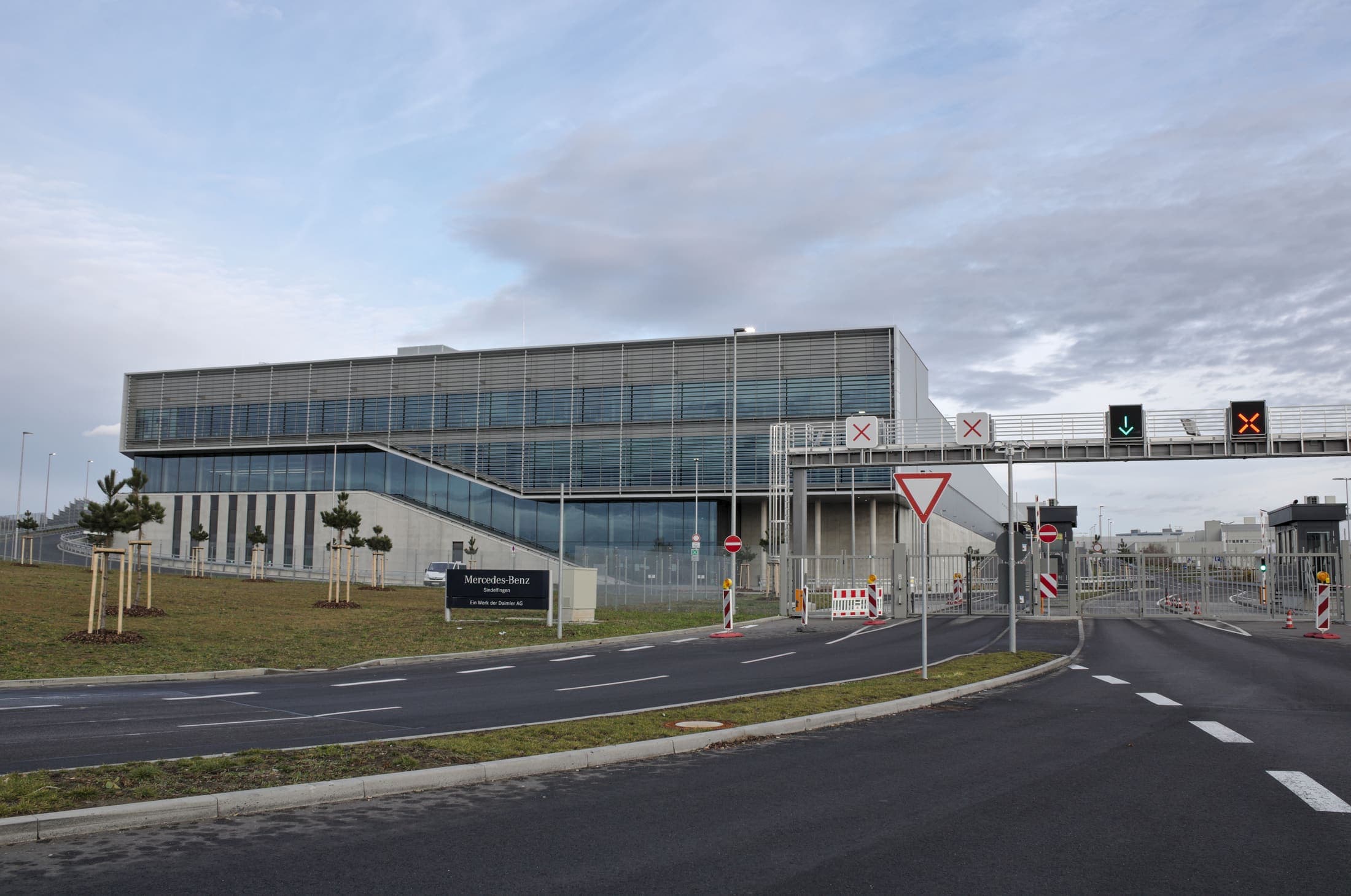
Photo credits: Mercedes-Benz Factory 56, Sindelfingen by Alexander Migl, CC BY-SA 4.0. Via Wikimedia Commons. All image credits
