
University of Bonn (Rheinische Friedrich-Wilhelms-Universität Bonn)
Quick Snapshot & Key Statistics
| Official Name | Rheinische Friedrich-Wilhelms-Universität Bonn (University of Bonn) |
| Institution Type | Public Comprehensive Research University / University of Excellence (Exzellenzuniversität) |
| Established | 1818 (Founded by King Frederick William III of Prussia) |
| Motto | Universitas Fridericia Guilelmia Rhenana |
| Total Enrollment | ~31,300+ Students (~5,200+ International Students from 130+ nations) |
| Academic Faculties | 7 Faculties | Over 200 Degree Programs |
| Excellence Status | 8 Clusters of Excellence (Most of any German university) |
| Nobel & Fields Laureates | 11 Nobel Laureates | 2 Fields Medalists (Germany's only Fields Medalists: Gerd Faltings & Peter Scholze) |
| Institutional Affiliations | German U15, German Excellence Strategy, EUA, UN Academic Impact |
| Main Campus Location | Bonn, North Rhine-Westphalia (NRW), Germany |
| Global Rankings | Ranked #4 in Germany & #68 Worldwide (ARWU Shanghai) | #91 Worldwide (QS) |
| Tuition Fees (Regular Degrees) | €0 / year (100% Tuition-Free for all EU & non-EU international students) |
| Semester Contribution | ~€315 to €340 per semester (Includes administrative fees & nationwide transit pass) |
About University of Bonn
Founded in 1818, the University of Bonn (Rheinische Friedrich-Wilhelms-Universität Bonn) is one of Germany's largest, most prestigious research universities. Officially designated as an elite University of Excellence, Bonn is the most successful university under Germany's national Excellence Strategy, securing a record 8 Clusters of Excellence—more than any other institution in the country.
Situated along the Rhine River in the former West German capital city of Bonn, the university is a global heavyweight in Mathematics, Theoretical Economics, Quantum Physics, Immunology, Crop Science, and Philosophy. Bonn stands out for its extraordinary mathematical legacy: it is the academic home of both German Fields Medalists (Gerd Faltings and Peter Scholze). It also collaborates closely with international organisations, including UN Agencies stationed in Bonn, the Max Planck Society, the Fraunhofer-Gesellschaft, and the German Centre for Neurodegenerative Diseases (DZNE).
Why Choose University of Bonn?
- Member of Germany's Universities of Excellence
- One of Germany's leading research universities
- Strong international reputation
- Excellent research facilities
- Wide range of academic disciplines
- Affordable public university education
- Numerous English-taught Master's programmes
- Close collaboration with international organisations
- Outstanding graduate employability
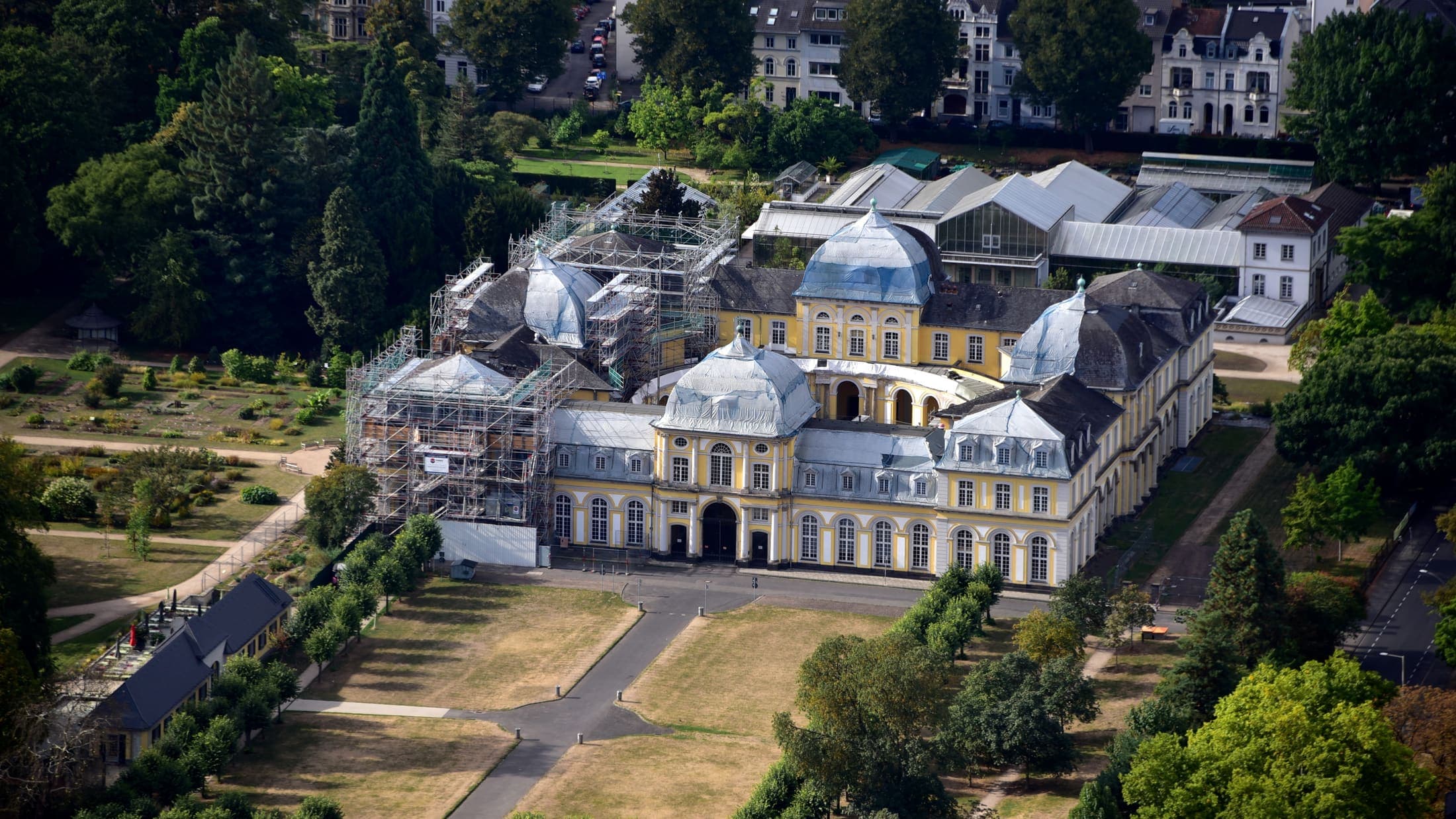
- Beautiful campus with historic architecture
Location & Campus Structure of University of Bonn
The University of Bonn operates as an urban, integrated university embedded across historic and high-tech campus hubs in Bonn, North Rhine-Westphalia:
- City Centre Campus (Kurfürstliches Schloss & Hofgarten): Centred around the historic Baroque Palace (Kurfürstliches Schloss) facing the Hofgarten park. Houses University Administration, the Main Library, the Faculty of Arts, Theology, and the Faculty of Law and Economics.
- Poppelsdorf Campus: A high-tech science complex featuring modern research laboratories for Agriculture, Biology, Geosciences, Computer Science, and the Hausdorff Centre for Mathematics.
- Endenich Campus: Located west of Poppelsdorf, housing the Argelander Institute for Astronomy, Nuclear Physics institutes, Pharmacy, and Musicology.
- Venusberg Campus: Located on the Venusberg hill overlooking the city, hosting the University Hospital Bonn (UKB), preclinical medical laboratories, and the ImmunoSensation² cluster.
Popular & Unique Degree Programs
The University of Bonn offers over 200 study programs across 7 academic faculties: Faculty of Protestant Theology, Faculty of Catholic Theology, Faculty of Agriculture, Faculty of Mathematics and Natural Sciences, Faculty of Medicine, Faculty of Law and Economics, and Faculty of Arts.
Top English-Taught Master's Programs (International Favourites)
- M.Sc. Mathematics: World-renowned graduate program hosted by the Hausdorff Centre for Mathematics, covering pure mathematics, algebraic geometry, probability, and analysis.
- M.Sc. Economics: Top-ranked theoretical and empirical economics program closely linked with the ECONtribute Cluster of Excellence and the Reinhard Selten Institute.
- M.Sc. Computer Science: Advanced algorithms, sensor networks, robotics, machine learning, and computer graphics.
- M.Sc. Immunobiology: Elite biomedical research track connected to the ImmunoSensation² cluster and University Hospital Bonn.
- M.Sc. Agricultural and Resource Economics (ARTS): Interdisciplinary program addressing global food security, sustainable resource use, and international agricultural trade.
- M.Sc. Astrophysics: Advanced observational astronomy, cosmology, and radio astronomy operated via the Argelander Institute.
Top German-Taught Degree Programs
- Human Medicine & Dentistry (Staatsexamen): Highly competitive clinical training operated at the University Hospital Bonn (UKB).
- Law (Rechtswissenschaft - Staatsexamen): One of Germany's premier law faculties, renowned for public law, international law, and legal philosophy.
- B.Sc. / M.Sc. Agricultural Sciences (Agrarwissenschaften): Germany's leading agricultural technology and soil science department.
- B.Sc. / M.Sc. Molecular Biomedicine: High-demand interdisciplinary program merging cell biology, pharmacology, and biochemistry.
- B.A. / M.A. Philosophy (Philosophie): Internationally recognised department featuring world-leading research in German Idealism, ethics, and epistemology.
Language Requirements (English & German)
Language requirements depend on the primary medium of instruction for your chosen degree program.
German Language Requirements (German-Taught Programs)
For degree programs taught in German, including standard Bachelor's degrees and State Examination programs like Medicine, Dentistry, and Law, non-native applicants must prove C1 CEFR German proficiency:
- DSH: DSH-2 or DSH-3.
- TestDaF: Minimum level of 4x4 (TDN 4 in all 4 examination sections).
- telc: telc Deutsch C1 Hochschule.
- Goethe-Zertifikat: Goethe-Zertifikat C2.
English Language Requirements (English-Taught Programs)
For international Bachelor's and Master's degree programs taught in English, applicants must submit proof of B2 or C1 CEFR English proficiency:
| IELTS Academic | Overall 6.5 or 7.0 (program-dependent) |
| TOEFL iBT | 87 to 100 points or higher |
| Cambridge English | C1 Advanced (CAE) or C2 Proficiency (CPE) |
| PTE Academic | 62 to 65 points or higher |
Fee Structure
As a public research university in North Rhine-Westphalia (NRW), University of Bonn does NOT charge tuition fees for standard Bachelor's, Master's, or Doctoral degree programs for any student, regardless of citizenship.
Bachelor's Programmes
- Tuition Fee: No tuition fees
- Semester Contribution: Approximately €315–€340 per semester
Master's Programmes
- Tuition Fee: No tuition fees
- Semester Contribution: Approximately €315–€340 per semester
Mandatory Administrative & Living Costs at University of Bonn
- Semester Contribution (Semesterbeitrag): ~€315 to €340 per semester (paid twice a year for re-registration).
- Blocked Account (Sperrkonto) for Visa: Non-EU international students must deposit €11,904 per year into an official Blocked Account to draw €992 per month for living costs.
- Monthly Living Costs in Bonn: Bonn is a comfortable, medium-sized federal city. On average, students spend between €850 and €1,100 per month.
Research & Industry Partnerships
University of Bonn collaborates with:
- Max Planck Society
- Fraunhofer Society
- German Aerospace Centre (DLR)
- United Nations University (UNU)
- Deutsche Telekom
- DHL Group
- Bayer
- Haribo
- Forschungszentrum Jülich
- German Institute of Development and Sustainability (IDOS)
These collaborations create opportunities for internships, research projects, innovation, and career development.
Let's plan your path to studying at University of Bonn
From matching your profile to the right faculty to preparing a compelling application, our counsellors guide every step of your journey.
Frequently Asked Questions (FAQs)
Under Germany's national Excellence Strategy, Bonn secured 8 Clusters of Excellence—the highest number awarded to any German university. These funding grants cover cutting-edge research in mathematics, quantum physics, robotics, economics, immunology, dependency studies, astrophysics, and plant sciences.
The Hausdorff Centre for Mathematics (HCM) is Germany's premier Cluster of Excellence in pure and applied mathematics. Named after topologist Felix Hausdorff, HCM unites pure analysis, numerical modelling, and mathematical economics, hosting world-renowned mathematicians including Fields Medallist Peter Scholze.
The University of Bonn is the only German university associated with both German recipients of the Fields Medal (the "Nobel Prize for Mathematics"): Gerd Faltings, awarded in 1986 for his proof of the Mordell conjecture and Peter Scholze, awarded in 2018 for his work on perfectoid spaces.
PhenoRob (Robotics and Phenotyping for Sustainable Crop Production) is Germany's only Cluster of Excellence focused on agriculture. It integrates robotics, computer vision, autonomous drones, machine learning, and plant biology to minimise chemical pesticide use and optimise sustainable crop yields.
BCDSS is an interdisciplinary Cluster of Excellence at Bonn that redefines historical and contemporary dependency research. It investigates forms of human bondage, forced labour, debt peonage, and asymmetrical social dependencies across ancient and modern civilisations.
The University of Bonn combines historic academic traditions with cutting-edge research, strong international partnerships, and close collaboration with global organisations and research institutes.
Created as part of Bonn's Excellence Strategy, Hertz Chairs bring world-renowned international researchers to lead transdisciplinary research areas (e.g., AI in neuroscience), while Argelander Professorships recruit top early-career scientists to establish early independent research groups.
Located in Germany's UN City (UN-Stadt Bonn), the university collaborates directly with UN entities such as UNFCCC, UNU-EHS, and UNCCD through joint research projects, international policy forums, and global environmental governance Master's modules.
The Reinhard Selten Institute is an economic research centre named in honour of Reinhard Selten, the University of Bonn professor who won the 1994 Nobel Memorial Prize in Economic Sciences for his work in game theory.
The Kurfürstliches Schloss (Electoral Palace) is the historic main building of the University of Bonn, gifted by King Frederick William III of Prussia in 1818. Facing the famous Hofgarten park, it houses the main lecture halls, university administration, and the Faculty of Arts.
The Argelander Institute for Astronomy at Bonn is an internationally acclaimed astrophysics department named after Friedrich Wilhelm Argelander, creator of the historic Bonner Durchmusterung star catalogue. It conducts research in observational radio astronomy, cosmology, and galaxy evolution.
Yes. The university encourages innovation through startup support, entrepreneurship programmes, mentoring, and collaboration with regional innovation networks.
Explore Other Universities in Germany
Photo credits: Poppelsdorfer Schloss, University of Bonn by Wolkenkratzer, CC BY-SA 4.0; UN Campus, Bonn by Wolkenkratzer, CC BY-SA 4.0. Via Wikimedia Commons. All image credits
