
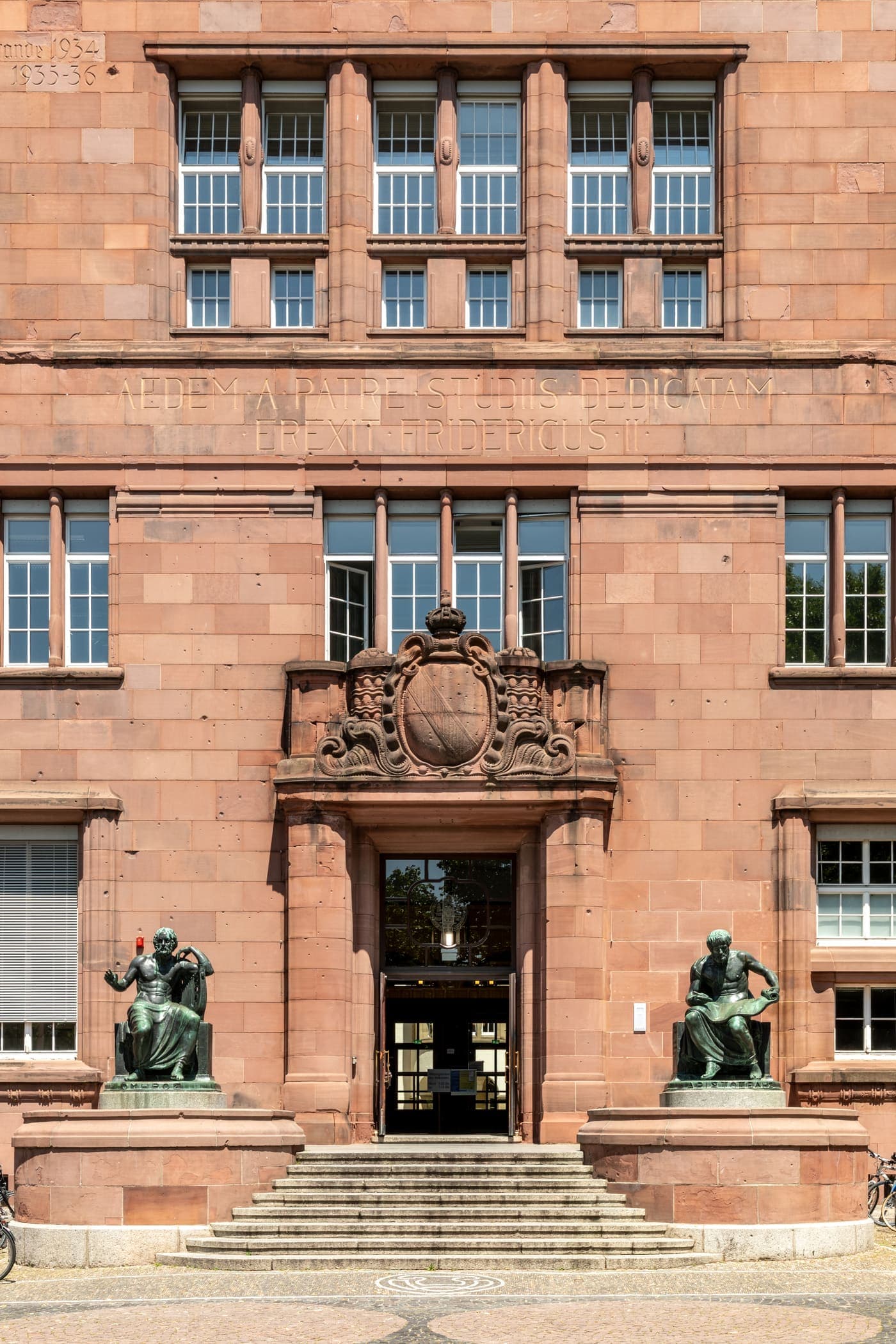
University of Freiburg (Albert-Ludwigs-Universität Freiburg)
Quick Snapshot & Key Statistics
| Official Name | Albert-Ludwigs-Universität Freiburg (University of Freiburg) |
| Institution Type | Public Comprehensive Research University |
| Established | 1457 (5th oldest university in Germany) |
| Motto | Die Wahrheit wird euch frei machen ("The truth will set you free") |
| Total Enrollment | ~24,500 Students (~18% International Students from 120+ nations) |
| Academic Faculties | 11 Faculties | Over 240 Degree Programs |
| Nobel Laureates | Associated with 23 Nobel Laureates (e.g., Friedrich Hayek, Hans Krebs, Robert Koch, George de Hevesy) |
| Institutional Affiliations | German U15, LERU (League of European Research Universities), EUCOR, EPICUR Alliance |
| Main Location | Freiburg im Breisgau, Baden-Württemberg, Germany |
| Global Rankings | Ranked Top 130–150 Worldwide (THE/ARWU) | Top 10–12 in Germany |
| Tuition Fees (Non-EU) | €1,500 per semester (~€3,000 / year under Baden-Württemberg state law) |
| Tuition Fees (EU/EEA) | €0 / year (Tuition-Free for EU/EEA citizens) |
| Semester Contribution | ~€180–€190 per semester (Administrative & student services contribution) |
About University of Freiburg
Founded in 1457 by the Habsburg dynasty, University of Freiburg (Albert-Ludwigs-Universität Freiburg) is one of Germany's oldest and most historically distinguished research institutions. Known worldwide for academic excellence in Medicine, Life Sciences, Microsystems Engineering, Forestry, Environmental Sciences, Philosophy, and Law, Freiburg consistently ranks among Europe's premier comprehensive research universities.
Located in Freiburg im Breisgau—Germany's sunniest city at the foot of the Black Forest and near the tri-border region of Germany, France, and Switzerland—the university is a founding member of the League of European Research Universities (LERU) and the EUCOR European Campus, a tri-national university alliance allowing cross-border study across 5 universities in France, Switzerland, and Germany.
Why Choose the University of Freiburg?
- One of Germany's oldest and most prestigious universities
- Member of Germany's Universities of Excellence
- Strong international reputation
- World-class research facilities
- Leader in sustainability and environmental research
- Affordable public university education
- Numerous English-taught Master's programmes
- Excellent international exchange opportunities
- Strong graduate employability
- Beautiful campus in one of Germany's most liveable cities
Location & Campus Structure of University of Freiburg
The University of Freiburg operates as an integrated urban university embedded directly into the city of Freiburg im Breisgau. Academic facilities are structured across three main campus sectors:
- City Centre Campus (Innenstadt): Centred around historical assembly buildings (Kollegiengebäude I–IV) and the iconic University Library (UB). Houses Humanities, Theology, Law, Economics, Social Sciences, and University College Freiburg (UCF).
- Institutsviertel (Science District): Located just north of the city centre. Houses the Faculties of Physics, Chemistry, Pharmacy, Mathematics, Earth Sciences, and Biology.
- High-Tech Airport Campus (Flugplatz): Located near the local airfield in northern Freiburg. Houses the Faculty of Engineering, IMTEK, Department of Computer Science, and neighbouring Fraunhofer research institutes.
- Medical Campus: Houses the world-renowned University Medical Centre Freiburg (Universitätsklinikum Freiburg), spanning specialised clinical complexes across the city.
Popular & Unique Degree Programs
University of Freiburg offers over 240 degree programs across 11 academic faculties: Faculty of Theology, Faculty of Law, Faculty of Economics and Behavioural Sciences, Faculty of Medicine, Faculty of Philology, Faculty of Humanities, Faculty of Mathematics and Physics, Faculty of Chemistry and Pharmacy, Faculty of Environment and Natural Resources, Faculty of Biology, and Faculty of Engineering.
Specialised English-Taught Programs (International Favourites)
- B.A. / B.Sc. Liberal Arts and Sciences (LAS): Offered by University College Freiburg (UCF), an elite 4-year English-taught interdisciplinary undergraduate degree featuring majors in Earth & Environmental Sciences, Life Sciences, Governance, or Culture & History.
- M.Sc. Microsystems Engineering (MSE): Hosted at IMTEK, covering micro-sensors, MEMS actuators, biomedical devices, and micro-optics.
- M.Sc. Renewable Energy Engineering and Management (REM): Focuses on solar thermal, photovoltaic systems, wind engineering, bioenergy, and environmental energy economics.
- M.Sc. Forest Sciences / Megacities: Advanced global forestry, ecological management, and urban ecosystem design.
- M.Sc. Solar Energy Engineering: Online/hybrid executive Master's operated in cooperation with Fraunhofer ISE.
- M.Sc. Neuroscience: Interdisciplinary program bridging cellular neurobiology, computational neuroscience, and cognitive systems.
Language Requirements (English & German)
Language prerequisites depend on the primary medium of instruction for your degree program at University of Freiburg.
German Language Requirements (German-Taught Programs)
For degree programs taught in German (including all standard Bachelor's degrees and State Examination programs like Medicine and Law), non-native applicants must prove C1 CEFR German proficiency:
- DSH: DSH-2 or DSH-3.
- TestDaF: Minimum level of 4x4 (TDN 4 in all 4 examination sections).
- telc: telc Deutsch C1 Hochschule.
- Goethe-Zertifikat: Goethe-Zertifikat C2.
English Language Requirements (English-Taught Programs)
For international Bachelor's (such as B.A./B.Sc. Liberal Arts and Sciences) and Master's programs taught in English, applicants must submit proof of B2 or C1 CEFR English proficiency:
| IELTS Academic | Overall 6.5 or 7.0 (program-dependent) |
| TOEFL iBT | 90 to 100 points or higher |
| Cambridge English | C1 Advanced (CAE) or C2 Proficiency (CPE) |
| PTE Academic | 65 points or higher |
Fee Structure at University of Freiburg
Because University of Freiburg is located in the state of Baden-Württemberg, state legislation mandates tuition fees for international students from non-EU/EEA countries enrolled in standard degree programs.
Bachelor's Programmes
- EU/EEA Students: No tuition fees
- Non-EU Students: €1,500 per semester (for most degree programmes)
- Semester contribution: Approximately €180–€190 per semester
Master's Programmes
- Consecutive Master's Programmes — EU/EEA Students: No tuition fees
- Consecutive Master's Programmes — Non-EU Students: €1,500 per semester (for most programmes)
- Semester contribution: Approximately €180–€190 per semester
- Exemptions: Certain students may qualify for tuition fee exemptions under Baden-Württemberg regulations.
Mandatory Administrative & Living Costs at University of Freiburg
- Semester Contribution (Semesterbeitrag): ~€180 to €190 per semester (paid twice a year for re-registration).
- Blocked Account (Sperrkonto) for Visa: Non-EU international students must deposit €11,904 per year into an official Blocked Account to draw €992 per month for living costs.
- Monthly Living Costs in Freiburg: On average, students spend between €850 and €1,050 per month.
Research & Industry Partnerships
University of Freiburg collaborates with leading research institutions and industry partners, including:
- Max Planck Society
- Fraunhofer Society
- Helmholtz Association
- Leibniz Association
- Bosch
- Siemens
- Roche
- Pfizer
- SAP
- FRIAS (Freiburg Institute for Advanced Studies)
These collaborations provide students with internships, research opportunities, innovation projects, and strong graduate employment prospects.
Let's plan your path to studying at University of Freiburg
From matching your profile to the right faculty to preparing a compelling application, our counsellors guide every step of your journey.
Frequently Asked Questions (FAQs)
EUCOR is a cross-border alliance between 5 universities in the Upper Rhine region: Freiburg, Karlsruhe (KIT), Basel (Switzerland), Strasbourg (France), and Haute-Alsace (France). Enrolled Freiburg students can take modules, access libraries, and attend exams at any of these partner universities without paying additional tuition fees, with travel costs subsidised by the alliance.
UCF is an interfaculty centre at Freiburg offering a 4-year, 240 ECTS English-taught B.A./B.Sc. in Liberal Arts and Sciences. Modelled on international honours colleges, it allows students to combine foundational interdisciplinary training with major tracks in Earth Sciences, Life Sciences, Governance, or Culture & History.
IMTEK (Institute of Microsystems Engineering) at Freiburg's Faculty of Engineering is one of the world's premier academic research centres for micro-technology. Housing over 24 professorships and its own cleanroom infrastructure, IMTEK conducts cutting-edge research in micro-sensors, bio-MEMS, micro-fluidics, and lab-on-a-chip devices.
Freiburg hosts five major Fraunhofer research institutes closely linked with university professorships: Fraunhofer ISE (Solar Energy Systems—the largest solar research institute in Europe), Fraunhofer IAF (Applied Solid State Physics), Fraunhofer IWM (Mechanics of Materials), Fraunhofer EMI (High-Speed Dynamics), and the affiliated Hahn-Schickard micro-technology institute.
CIBSS (Centre for Integrative Biological Signalling Studies) is a Cluster of Excellence at Freiburg exploring biological signalling processes from single molecules to complex organs. It builds upon the legacy of BIOSS (Centre for Biological Signalling Studies) in pioneering synthetic biology and optogenetics.
livMatS (Living, Adaptive and Energy-autonomous Material Systems) is an interdisciplinary Cluster of Excellence at Freiburg developing bio-inspired, self-healing, energy-autonomous material systems that adapt dynamically to environmental changes.
FRIAS is the university's international research college (Wissenschaftskolleg). It invites top global scholars, Nobel laureates, and research fellows for residential research stays, fostering interdisciplinary symposia across humanities, natural sciences, and engineering.
The Universitätsklinikum Freiburg is one of Germany's largest university medical centres, internationally recognised for cardiovascular medicine, oncology, neurosurgery, and gene therapy research.
EPICUR (European Partnership for an Innovative Campus Unifying Regions) is a European University initiative connecting Freiburg with 8 partner universities across 6 European countries, including Poznań, Amsterdam, Vienna, and Strasbourg, to create seamless virtual and physical European study tracks.
Freiburg's Faculty of Environment and Natural Resources is one of Europe's leading research bodies combining forestry sciences, hydrology, meteorology, environmental governance, and land-use management under a single integrated interdisciplinary faculty.
FIT is an interdisciplinary central research institute where chemists, physicists, biologists, and engineers collaborate on developing smart materials, polymer systems, and bio-inspired nanostructures.
Yes. Under Baden-Württemberg state law, doctoral candidates at the University of Freiburg are exempt from the €1,500-per-semester non-EU tuition fee and pay only the standard semester contribution (~€180–€190).
The University Library (UB Freiburg) is one of Germany's most modern academic libraries, holding over 3.4 million printed media volumes and 1.7 million electronic resources. It features a distinctive energy-efficient glass facade, 24/7 study zones, specialised media centres, and silent reading rooms (Parlatorium).
Explore Other Universities in Germany
Photo credits: University of Freiburg, Kollegiengebäude I by Dietmar Rabich, CC BY-SA 4.0; University of Stuttgart (Cyber Valley partner) by MSeses, CC BY-SA 4.0. Via Wikimedia Commons. All image credits
