

HM Hochschule München (University of Applied Sciences)
Quick Snapshot & Key Statistics
| Official Name | HM Hochschule München University of Applied Sciences |
| Institution Type | Public University of Applied Sciences (Hochschule für angewandte Wissenschaften - HAW) |
| Established | 1971 (Merging 7 predecessor technical and vocational colleges) |
| Total Enrollment | ~18,500+ Students (~2,500+ International Students from 100+ nations) |
| Academic Faculties | 14 Departments (Fachbereiche) + MUC.DAI + MUC.HEALTH | Over 80 Degree Programs |
| National Rankings | Ranked #1 in Germany for Computer Science & Business Informatics (WirtschaftsWoche HAW Rankings) | Top 2–3 across engineering & management |
| Industry Partners | Direct research and internship partnerships with BMW, Siemens, Allianz, Munich Re, Amazon, MAN, and Rohde & Schwarz |
| Main Location | Munich (München), Bavaria (Bayern), Germany |
| Tuition Fees (Non-EU Students) | €500 per semester (Bachelor's) | €700 per semester (Master's) |
| Tuition Fees (EU/EEA Students) | €0 / semester (Tuition-free for EU/EEA citizens) |
| Semester Contribution | ~€97 per semester (Studierendenwerk contribution) |
About Hochschule München (HM)
As the largest university of applied sciences in Bavaria and the second-largest in Germany, HM Hochschule München (HM) is an academic powerhouse for practical, industry-integrated higher education. HM is globally renowned for its hands-on approach to learning, requiring mandatory practical internship semesters (Praxissemester) integrated directly into degree curricula.
Located in the economic heart of Munich—Continental Europe's leading high-tech and business hub—HM maintains close co-development ties with DAX-listed corporations, tech startups, and research institutes. The university is home to the Strascheg Centre for Entrepreneurship (SCE), one of Germany's premier startup incubators, fostering entrepreneurship, digital transformation, and sustainable innovation.
Why Choose HM Hochschule München?
- One of Germany's largest universities of applied sciences
- Strong focus on practical and industry-oriented education
- 14 faculties and over 80 degree programmes
- Excellent industry partnerships
- Affordable public university education
- Numerous English-taught Master's programmes
- Modern laboratories and innovation centres
- Strong international exchange programmes
- Excellent graduate employability
- Located in Germany's technology and business hub
Location & Campus Structure of HM
HM operates as an urban university integrated across three main campus hubs within the city of Munich:
- Campus Lothstraße (Main Campus): Located near central Munich. Houses the Faculties of Mechanical, Automotive & Aeronautical Engineering, Electrical Engineering, Computer Science, Applied Sciences, Engineering & Management, Design, and the Strascheg Centre for Entrepreneurship.
- Campus Karlstraße: Located in the museum district (Maxvorstadt). Houses the Faculties of Architecture, Civil Engineering, and Building Services Engineering.
- Campus Pasing: Located in the green western district of Pasing. Houses the Faculties of Business Administration, Tourism, and Applied Social Sciences.
Popular and Unique Degree Programs
HM Hochschule München is structured into 14 main academic departments (Fachbereiche)—spanning Architecture, Civil Engineering, Mechanical, Automotive and Aeronautical Engineering, Electrical Engineering and Information Technology, Building Services Engineering, Applied Sciences and Mechatronics, Computer Science and Mathematics, Geoinformatics, Engineering and Management, Business Administration, Applied Social Sciences, Design, General and Interdisciplinary Studies, and Tourism—which collectively offer over 80 practice-oriented Bachelor's and Master's degree programs.
Top English-Taught Master's Programs
- M.A. Entrepreneurship and Digital Transformation: High-level program bridging digital business models, technology innovation, and venture creation at the Strascheg Centre.
- M.Sc. Business Administration - Digital Technology Management: Focuses on enterprise digitalisation, technology strategy, data analytics, and digital supply chains.
- M.Sc. International Management and Digital Engineering: Cross-disciplinary track merging global supply chain management with industrial IoT systems.
- M.Sc. Micro- and Nanotechnology: Advanced research program covering semiconductor physics, cleanroom engineering, and nano-sensor fabrication.
- M.Sc. Photonics: Research-focused degree covering laser technology, optical engineering, and quantum optics.
- M.Sc. Sustainable Energy Engineering: Green technology track covering renewable grid integration, energy storage systems, and building performance.
Top German-Taught Degree Programs
- B.Sc. / M.Sc. Computer Science (Informatik): Consistently ranked #1 in Germany among Universities of Applied Sciences for software engineering and AI.
- B.Eng. Automotive Engineering (Fahrzeugtechnik): World-class automotive degree operating in direct collaboration with BMW, Audi, and automotive suppliers.
- B.Sc. / M.Sc. Business Informatics (Wirtschaftsinformatik): Top-ranked program bridging enterprise software architectures and financial management.
- B.Eng. Mechanical Engineering (Maschinenbau): Hands-on engineering program featuring state-of-the-art CAD labs and robotics testing halls.
- B.A. Business Administration (BWL): High-demand undergraduate management program incorporating international study modules and mandatory corporate internships.
Language Requirements
Language prerequisites depend on the primary medium of instruction for your degree program at HM.
German Language Requirements (German-Taught Programs)
For degree programs taught in German (including all standard Bachelor's degrees), non-native applicants must prove C1 CEFR German proficiency:
- TestDaF: Minimum level of 4x4 (TDN 4 in all 4 examination sections).
- DSH: DSH-2 or DSH-3.
- telc: telc Deutsch C1 Hochschule.
- Goethe-Zertifikat: Goethe-Zertifikat C1 or C2.
English Language Requirements (English-Taught Programs)
For international Master's degree programs taught in English, applicants must submit proof of B2 or C1 CEFR English proficiency:
| IELTS Academic | Overall 6.5 or 7.0 (program-dependent) |
| TOEFL iBT | 88 to 95 points or higher |
| Cambridge English | C1 Advanced (CAE) or C2 Proficiency (CPE) |
| PTE Academic | 65 points or higher |
Fee Structure & Living Costs
HM charges modest tuition fees for non-EU students under Bavarian state law (BayHIG), alongside standard administrative fees.
Bachelor's Programmes
- EU/EEA Students: No tuition fees
- Non-EU Students: €500 per semester
- Semester Contribution: Approximately €85 to €150 per semester
Master's Programmes
- EU/EEA Students: No tuition fees
- Non-EU Students: €700 per semester
- Semester Contribution: Approximately €85 to €150 per semester
Mandatory Administrative & Living Costs
- Semester Contribution (Semesterbeitrag): ~€85 to €150 per semester.
- Blocked Account (Sperrkonto) for Visa: Non-EU international students must deposit €11,904 per year into an official Blocked Account to draw €992 per month for living costs.
- Monthly Living Costs in Munich: Munich is a high-cost, high-opportunity economic hub. On average, students budget between €1,000 and €1,350 per month.
Research & Industry Partnerships
Hochschule München (HM) collaborates with leading companies and organisations, including:
- BMW
- Siemens
- MAN Truck & Bus
- Airbus
- Bosch
- Allianz
- Microsoft
- Rohde & Schwarz
- Munich Airport
These partnerships provide students with internships, industry projects, applied research opportunities, and excellent career prospects.
Let's plan your path to studying at HM Hochschule München
From matching your profile to the right faculty to preparing a compelling application, our counsellors guide every step of your journey.
Frequently Asked Questions (FAQs)
Munich's high-tech hub—home to BMW, Siemens, Google, Apple, and Amazon—provides HM students with extensive Werkstudent job opportunities. Under German labour regulations, students can work up to 20 hours per week during term time and full-time during breaks. Offering competitive rates of €16 to €24+ per hour in engineering, IT, and business, these roles frequently lead to full-time post-graduate careers.
Yes. Unlike theoretical universities, all standard Bachelor's programs at HM require a mandatory 20-week full-time Praxissemester in the 5th or 6th semester. Students work inside a corporate company or industrial partner, gaining professional experience, earning a monthly intern salary, and writing their internship report for academic credits.
The SCE is HM's official startup incubator. It provides HM students with free co-working spaces, prototyping equipment, equity-free startup grants (such as the EXIST scholarship), pitch coaching, and direct access to venture capital investors.
HM offers Dual Study options (Studium mit vertiefter Praxis or Verbundstudium) combining academic study with paid industrial training. Students sign a contract with a partner company (e.g., BMW or Siemens), alternating between university lectures and paid work phases throughout their degree.
The Courses in English (CiE) program offers over 100 individual lectures, seminars, and laboratory classes taught in English across all 14 departments each semester. Enrolled students can take these classes as elective modules to internationalise their degree transcript.
International applicants applying with a non-German secondary school certificate or Bachelor's degree must first evaluate their documents through uni-assist to receive a Preliminary Documentation (VPD). Once the VPD is issued, students submit their final application via HM's online portal (PRIMUSS).
While TUM focuses on theoretical research and fundamental science, HM focuses on applied engineering, industry-driven problem solving, smaller class sizes, and direct corporate projects. HM professors are required by state law to have at least five years of professional industry experience outside academia before being appointed.
Bachelor's programs at HM are subject to selection cutoffs (Numerus Clausus - NC) based on secondary school grades (Abitur equivalent). High-demand programs like Computer Science, Business Administration, and Automotive Engineering require strong academic grades and proof of certified C1 German proficiency.
Yes. Over 80% of HM engineering, computer science, and business students write their final thesis (Bachelorarbeit / Masterarbeit) in direct collaboration with an industrial firm (e.g., Siemens, BMW, or a local startup), addressing a real-world technical or corporate problem while being paid a monthly thesis stipend.
Student accommodation is managed by Studierendenwerk München Oberbayern. Dorm rooms cost between €350 and €550 per month. Because housing in Munich is competitive, incoming students should apply for dorm housing through the Studierendenwerk portal immediately upon receiving admission.
Yes. While Universities of Applied Sciences traditionally offered degrees up to the Master's level, HM operates cooperative doctoral programs (Kooperative Promotion) in partnership with traditional universities, as well as independent doctoral centres funded under Bavaria's High-Tech Agenda.
For the Winter Semester (starting in October), the primary application period runs from May 2 to July 15. For the Summer Semester (starting in March), the application period runs from November 15 to January 15. International applicants requiring a visa should apply as early as possible.
Choose Hochschule München (HM) if you want a practical, career-focused education with strong industry connections, modern facilities, and excellent employment prospects. Its location in Munich and close collaboration with global companies make Hochschule München (HM) one of Germany's top choices for applied sciences and professional education.
Explore Other Universities in Germany
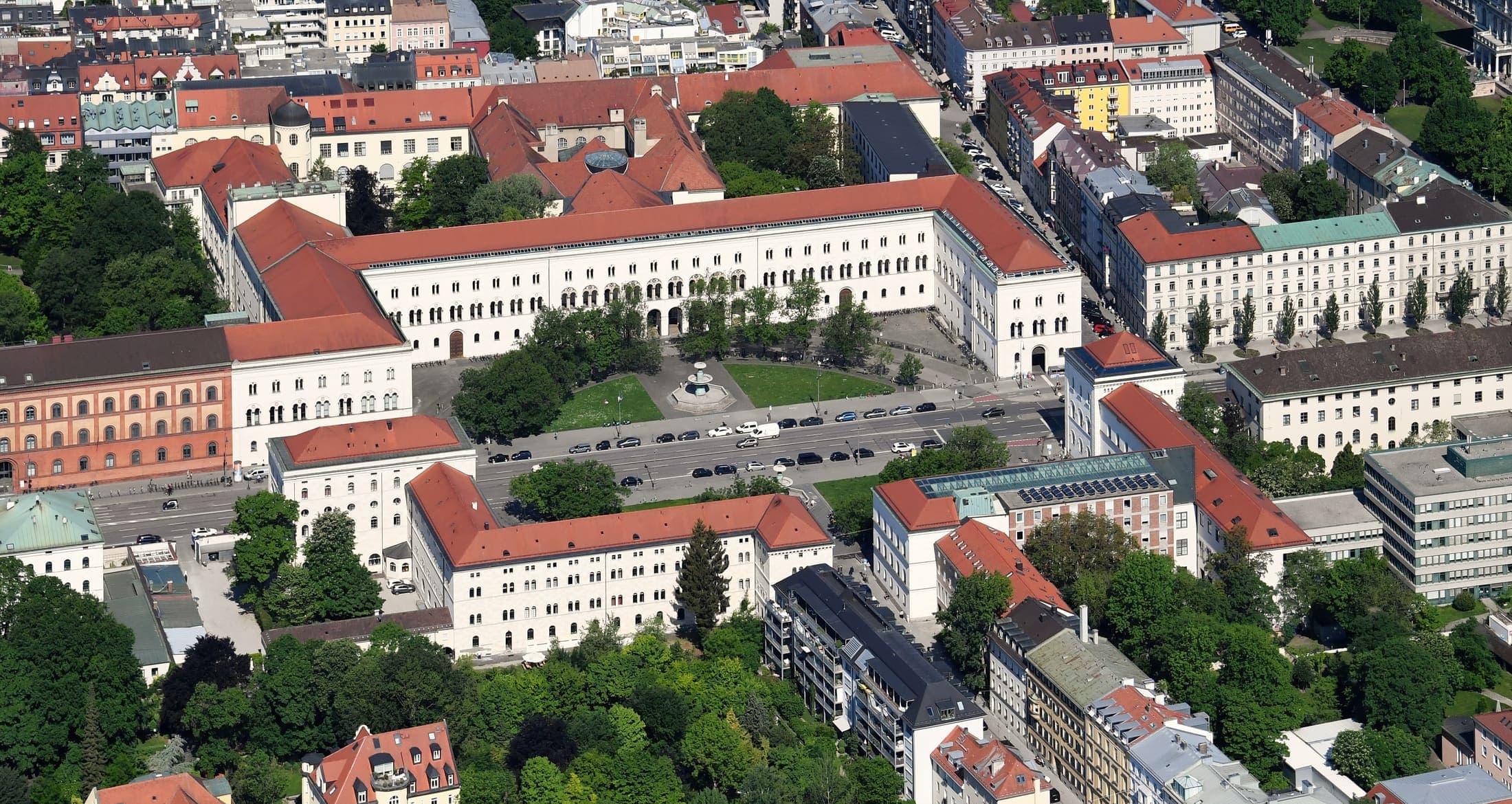
Photo credits: LMU Munich (aerial) by Carsten Steger, CC BY-SA 4.0. Via Wikimedia Commons. All image credits
