

Humboldt-Universität zu Berlin (HU Berlin)
Quick Snapshot & Key Statistics
| Official Name | Humboldt-Universität zu Berlin (HU Berlin / Humboldt University of Berlin) |
| Institution Type | Public Research University / University of Excellence (Exzellenzuniversität) |
| Established | 1810 (Founded by Wilhelm von Humboldt) |
| Motto | Universitas litterarum ("Mother of all modern universities") |
| Total Enrollment | ~35,000–36,000+ Students (~18% International Students) |
| Academic Faculties | 9 Faculties | Over 180 Degree Programs |
| Nobel Laureates | Associated with 55+ Nobel Laureates (e.g., Albert Einstein, Max Planck, Erwin Schrödinger, Robert Koch) |
| Institutional Affiliations | Berlin University Alliance (BUA), German Excellence Strategy, European University Association |
| Main Location | Unter den Linden, Mitte (Central Berlin), Germany |
| Global Rankings | Ranked #130 Worldwide (QS) | Ranked #1 in Germany for Humanities |
| Tuition Fees (Regular Degrees) | €0 / year (100% Tuition-Free for all EU & non-EU international students) |
| Semester Contribution | ~€315 to €355 per semester (Includes nationwide Deutschlandticket transit pass) |
About Humboldt-Universität zu Berlin
Founded in 1810 by the visionary educational reformer Wilhelm von Humboldt, Humboldt-Universität zu Berlin (HU Berlin) is one of Europe's most famous higher education institutions. It established the Humboldtian Model of Higher Education, which pioneered the integration of holistic liberal arts education with cutting-edge scientific research—a model adopted by universities globally.
Designated as an official University of Excellence under Germany's national Excellence Strategy, HU Berlin operates as a central partner in the Berlin University Alliance (BUA) alongside Free University of Berlin (FU Berlin), Technical University of Berlin (TU Berlin), and Charité – Universitätsmedizin Berlin.
Why Choose HU Berlin?
- One of Germany's oldest and most prestigious universities
- Founder of the modern research university model
- Member of the Berlin University Alliance
- Part of Germany's Universities of Excellence initiative
- Strong international reputation
- Excellent research facilities
- Affordable public university education
- Wide range of academic disciplines
- Numerous English-taught Master's programmes
- Outstanding graduate employability
Location & Campus Structure of HU Berlin
Humboldt-Universität zu Berlin is integrated into the heart of Berlin, Germany's capital city. The university operates across three main historic and high-tech campus locations:
- Campus Mitte (Historic City Centre): Situated along the iconic Unter den Linden boulevard in Berlin-Mitte. Houses the main historic building, central university library (Jacob-und-Wilhelm-Grimm-Zentrum), and faculties of Law, Arts & Humanities, Theology, Philosophy, History, and Economics & Business.
- Campus Nord (Mitte / Life Sciences): Located near the Charité medical campus north of Hauptbahnhof. Houses the Faculty of Life Sciences, Mind & Brain School, and agricultural sciences.
- Campus Adlershof (Technology & Natural Sciences): Located in southeastern Berlin at WISTA Adlershof—one of Europe's largest science and technology parks. Houses Computer Science, Physics, Chemistry, Mathematics, Geography, and Psychology.
Popular Courses at HU Berlin
HU Berlin offers over 180 study programs across nine core academic faculties and schools, alongside the jointly operated Charité – Universitätsmedizin Berlin medical school. Its academic divisions comprise the Faculty of Law, Faculty of Theology, School of Business and Economics, Faculty of Arts and Humanities, Faculty of Language, Literature and Humanities, Faculty of Humanities and Social Sciences, Faculty of Life Sciences, and Faculty of Mathematics and Natural Sciences.
Top English-Taught Master's Programs (International Favourites)
- M.Sc. Mind and Brain: Elite cognitive science and neuroscience program hosted at the Berlin School of Mind and Brain.
- M.Sc. Computer Science: Advanced algorithmic theory, artificial intelligence, software engineering, and computational modelling.
- M.Sc. Quantitative Molecular Biology: Interdisciplinary track merging systems biology, genetics, and computational biophysics.
- M.Sc. Information Systems: Bridges computer science, enterprise data architectures, and business intelligence.
- M.A. International Relations: Joint program offered together with Free University of Berlin and University of Potsdam.
- M.Sc. Polymer Science: Joint elite Master's degree operated with FU Berlin, TU Berlin, and University of Potsdam.
Top German-Taught Degree Programs
- Human Medicine & Dentistry (Staatsexamen): Jointly conducted at Charité – Universitätsmedizin Berlin.
- Law (Rechtswissenschaft - Staatsexamen): Ranked among the top law faculties in Europe.
- B.A. / M.A. Philosophy & Cultural Sciences: Globally renowned classical humanities department.
- B.Sc. / M.Sc. Psychology: Features competitive national admission cutoffs (Numerus Clausus - NC).
- B.A. / M.A. History and Social Sciences: World-class historical and political science research.
Language Requirements (English & German)
Language prerequisites depend on the primary medium of instruction for your degree program.
German Language Requirements (German-Taught Programs)
For degree programs taught in German (including all undergraduate Bachelor's degrees and many Master's tracks), non-native applicants must prove C1 CEFR German proficiency:
- TestDaF: Minimum level of 4x4 (TDN 4 in all 4 examination sections).
- DSH: DSH-2 or DSH-3.
- telc: telc Deutsch C1 Hochschule.
- Goethe-Zertifikat: Goethe-Zertifikat C2: GDS.
English Language Requirements (English-Taught Programs)
HU Berlin offers an extensive range of international Master's degree programs taught 100% in English. Applicants must submit proof of B2 or C1 CEFR English proficiency:
| IELTS Academic | Overall 6.5 or 7.0 (program-dependent) |
| TOEFL iBT | 85 to 100 points or higher |
| Cambridge English | C1 Advanced (CAE) or C2 Proficiency (CPE) |
| PTE Academic | 62 to 65 points or higher |
Fee Structure at HU Berlin
As a public research university in the state of Berlin, HU Berlin does NOT charge tuition fees for standard Bachelor's and consecutive Master's degree programs for any student, regardless of citizenship.
Bachelor's Programmes
- Tuition Fee: No tuition fees
- Semester Contribution: Approximately ~€315–€355 per semester
Master's Programmes
- Tuition Fee: No tuition fees
- Semester Contribution: Approximately ~€315–€355 per semester
Mandatory Administrative & Living Costs in Berlin
- Semester Fee: ~€315–€355 per semester (paid twice annually).
- Blocked Account (Sperrkonto) for Visa: Non-EU international students must deposit €11,904 per year into an official Blocked Account to draw €992 per month for living costs.
- Monthly Living Costs in Berlin: On average, students spend between €950 and €1,250 per month (covering student dorm/WG rent: €400–€650, statutory health insurance: ~€140/month, food, and daily expenses).
Research & Industry Partnerships
HU Berlin collaborates with leading organisations and companies, including:
- Charité – Universitätsmedizin Berlin
- Max Planck Society
- Fraunhofer Society
- Helmholtz Association
- Leibniz Association
- Siemens
- SAP
- Bayer
- Deutsche Telekom
- Zalando
These collaborations provide students with research opportunities, internships, innovation projects, and excellent graduate employment prospects.
Let's plan your path to studying at HU Berlin
From matching your profile to the right faculty to preparing a compelling application, our counsellors guide every step of your journey.
Frequently Asked Questions (FAQs)
No. HU Berlin is a public research university where standard Bachelor's and consecutive Master's degrees are 100% tuition-free for both EU and non-EU international students. Students pay only a mandatory semester contribution of approximately €315-€355 per semester.
HU Berlin is world-famous as the home of the "Humboldtian Model of Higher Education". It ranks #1 in Germany for Humanities and Social Sciences and is celebrated for Law, Philosophy, Life Sciences, and its medical faculty alliance with Charité Berlin.
AGNES is HU Berlin's central online campus management system. Students use AGNES to register for modules and lectures, sign up for semester examinations, download official enrollment certificates, check exam grades, and re-register (Rückmeldung) for upcoming semesters.
Applicants with secondary school or university credentials earned outside Germany must apply through uni-assist for credential evaluation. Depending on the specific program, applicants either submit their full dossier via uni-assist or receive a Preliminary Documentation (VPD) to complete their final enrolment through HU Berlin's internal admissions portal.
HU Berlin is located in Berlin, Germany, spread across three major campuses: Campus Mitte (historic central campus on Unter den Linden), Campus Nord (life sciences near Charité), and Campus Adlershof (natural sciences and computer science).
Charité is the joint medical faculty operated co-equally by HU Berlin and Freie Universität Berlin (FU Berlin). It is one of Europe's largest university hospitals. Students studying Human Medicine, Dentistry, and Health Sciences receive their education through Charité and graduate with degrees validated by both institutions.
Admission for restricted degree programs (NC - Numerus Clausus) at HU Berlin is highly competitive due to the university's global prestige and location. Popular subjects like Business Administration, Psychology, Computer Science, and Law are cut off based on top-tier secondary school or Bachelor's grades. However, a significant portion of specialised Master's and natural science programs remain non-NC (zulassungsfrei) provided formal entry criteria are met.
Berlin's status as a capital city, tech hub, and startup centre home to Zalando, N26, Delivery Hero, and numerous international organisations provides HU Berlin students with extensive Werkstudent positions. Under German labour regulations, enrolled students can work up to 20 hours per week during term time and full-time during semester breaks. Positions in IT, data science, research, economics, and marketing pay competitive rates (€15 to €23+ per hour) and frequently serve as direct pathways into post-graduate employment.
Student accommodation is managed independently by Studierendenwerk Berlin. Dormitory rents range from €250 to €480 per month including utilities. Because dorm placement is not guaranteed and waitlists can be long, incoming international students should submit an online housing application through the Studierendenwerk portal immediately upon receiving admission.
For the Winter Semester (October start), international applications generally close on June 15 or July 15. For the Summer Semester (April start), applications close on January 15.
HU Berlin is internationally recognised for research in artificial intelligence, mathematics, physics, climate science, life sciences, economics, humanities, and social sciences.
Yes. HU Berlin partners with institutions such as Charité, the Max Planck Society, the Helmholtz Association, and universities worldwide to promote research and innovation.
Its rich academic history, pioneering research model, Excellence status through the Berlin University Alliance, world-class research, and international collaborations make HU Berlin one of Germany's most respected universities.
Humboldt-Universität zu Berlin (HU Berlin) is an excellent choice for students seeking a globally respected degree, affordable public education, outstanding research opportunities, and strong career prospects. Its historic legacy, modern research environment, and location in Berlin provide students with an exceptional academic and cultural experience.
Explore Other Universities in Germany
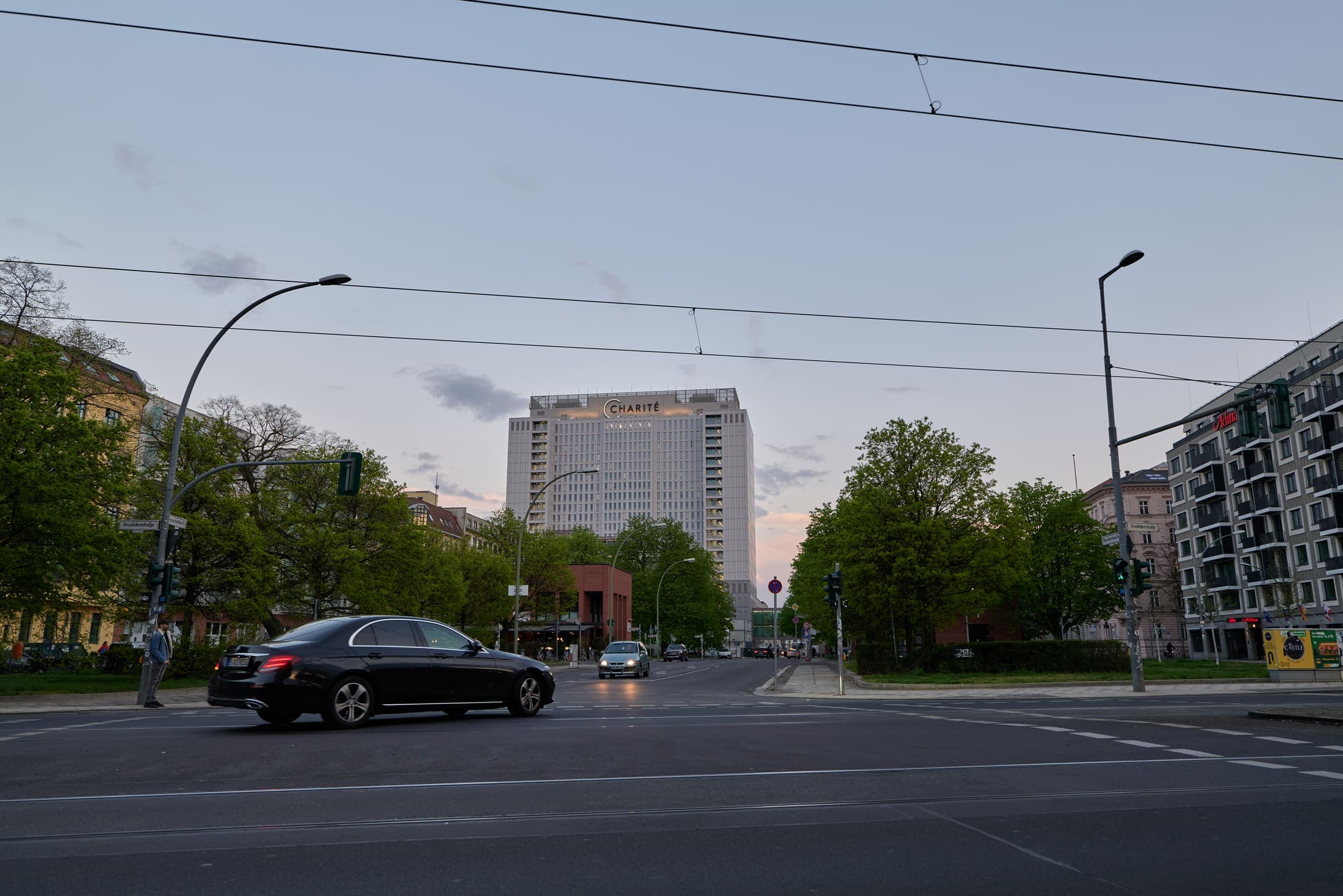
Photo credits: Humboldt University, Berlin by Diego Delso, CC BY-SA 4.0; Charité hospital high-rise, Berlin by Leonhard Lenz, CC0. Via Wikimedia Commons. All image credits
