
Technische Universität Dresden (TU Dresden)
Quick Snapshot & Key Statistics
| Official Name | Technische Universität Dresden (TU Dresden / Dresden University of Technology) |
| Institution Type | Public Research University / University of Excellence (Exzellenzuniversität) |
| Established | 1828 (Royal Saxon Technical School) |
| Motto | Wissen schaffenden Wandel ("Knowledge builds change") |
| Total Enrollment | ~30,000+ Students (~18% International Students from 120+ nations) |
| Academic Schools | 5 Academic Schools | 17 Faculties | Over 120 Degree Programs |
| Excellence Status | Sole "University of Excellence" in Eastern Germany (Outside Berlin) |
| Institutional Affiliations | TU9 Alliance, DRESDEN-concept, Silicon Saxony, CESAER, T.I.M.E. Association |
| Main Campus Location | Südvorstadt / Räcknitz (Dresden, Saxony, Germany) |
| Tuition Fees (Regular Degrees) | €0 / year (100% Tuition-Free for both EU & non-EU international students) |
| Semester Contribution | ~€310 per semester (Includes administrative and student welfare fees) |
About Technische Universität Dresden
Founded in 1828, Technische Universität Dresden (TU Dresden) is one of Germany's largest, most prestigious technical institutions and an international flagship for engineering, microelectronics, quantum physics, and life sciences. TU Dresden holds the distinguished title of University of Excellence under Germany's national Excellence Strategy, making it the only university in the eastern German federal states (outside Berlin) to achieve this premier research status.
TU Dresden is a prominent member of the TU9 Alliance (Germany's coalition of leading institutes of technology) and forms the academic anchor of Silicon Saxony—Europe's largest semiconductor microelectronics cluster. Through its local research network DRESDEN-concept, TU Dresden connects university labs directly with over 30 non-university research giants, including Max Planck, Fraunhofer, Leibniz, and Helmholtz institutes.
Why Choose TU Dresden?
- One of Germany's Universities of Excellence
- Strong reputation in engineering, science, and technology
- World-class research facilities
- Affordable public university education
- Excellent industry collaborations
- Wide range of English-taught Master's programmes
- International campus with students from over 120 countries
- Strong graduate employability
- Excellent research and internship opportunities
- Modern laboratories and innovation centres
Campus Locations & Ecosystem
TU Dresden is situated in Dresden, the capital city of Saxony, often referred to as "Florence on the Elbe" for its historic architecture, as well as Europe's primary microelectronics hub.
The university is structured across four primary regional campuses:
- Main Campus (Südvorstadt / Räcknitz): The historic and sprawling urban campus housing the administrative core, the Saxon State and University Library (SLUB), and the Schools of Engineering Sciences, Civil & Environmental Engineering, and Natural Sciences.
- Campus Johannstadt: Located along the Elbe River, housing the Faculty of Medicine, the University Hospital Carl Gustav Carus, and world-renowned biomedical research centres like the CRTD.
- Campus Tharandt: Situated southwest of Dresden in Tharandt, housing one of the world's oldest academic forestry training centres (founded in 1811).
- Central Institute IHI Zittau: Located at the border region of Germany, Poland, and the Czech Republic, specialising in ecosystem services, biotechnology, and environmental management.
Popular & Unique Degree Programs
TU Dresden offers over 120 degree programs distributed across 5 academic schools: School of Engineering Sciences, School of Civil and Environmental Engineering, School of Science, School of Humanities and Social Sciences, and School of Medicine.
Specialised English-Taught Master's Programs
- M.Sc. Nanoelectronic Systems: Specialised microelectronics track operating directly alongside Silicon Saxony semiconductor industries.
- M.Sc. Computational Modelling and Simulation (CMS): Interdisciplinary program bridging computer science, data analytics, computational materials, and biophysics.
- M.Sc. Distributed Systems Engineering (DSE): Focuses on cloud architectures, network protocols, middleware, and secure software systems.
- M.Sc. Organic and Molecular Electronics (OME): Specialised research program covering flexible electronics, organic photovoltaics, and molecular nanostructures.
- M.Sc. Physics of Life: Advanced biophysics degree linked directly to the PoL Cluster of Excellence.
Traditional German "Diplom-Ingenieur" (Dipl.-Ing.) Tracks
Unlike most German universities that converted entirely to separate Bachelor's/Master's cycles under the Bologna Process, TU Dresden purposefully retained its single-tier 5-year Diplom-Ingenieur (Dipl.-Ing.) degree options due to massive demand from German industrial employers:
- Dipl.-Ing. Mechanical Engineering (Maschinenbau)
- Dipl.-Ing. Electrical Engineering (Elektrotechnik)
- Dipl.-Ing. Computer Science (Informatik)
- Dipl.-Ing. Civil Engineering (Bauingenieurwesen)
Fee Structure at TU Dresden
As a public research university in Saxony, TU Dresden does NOT charge tuition fees for standard Bachelor's, Master's, or Diploma degree programs for any student, regardless of citizenship.
Bachelor's Programmes
- Tuition Fee: No tuition fees
- Semester Contribution: Approximately €310 per semester
Master's Programmes
- Tuition Fee: No tuition fees
- Semester Contribution: Approximately €310 per semester
Mandatory Administrative & Living Costs at TU Dresden
- Semester Contribution (Semesterbeitrag): ~€310 per semester (paid twice a year for re-registration). This includes the Deutschlandticket Semester pass, granting unlimited regional bus, tram, and train travel across all of Germany.
- Blocked Account (Sperrkonto) for Visa: Non-EU international students must deposit €11,904 per year into an official Blocked Account to draw €992 per month for visa approval and living expenses.
- Monthly Living Costs in Dresden: Dresden is one of the most budget-friendly student cities among German tech hubs. On average, students spend between €800 and €1,000 per month.
Let's plan your path to studying at TU Dresden
From matching your profile to the right faculty to preparing a compelling application, our counsellors guide every step of your journey.
Frequently Asked Questions (FAQs)
TU Dresden is the sole university in the former East German federal states (outside Berlin) to hold the official status of University of Excellence. This designation grants TU Dresden tens of millions of euros in direct federal research funding, supporting its elite Clusters of Excellence in quantum materials, tactile internet, and living systems physics.
Silicon Saxony is Europe's largest microelectronics and semiconductor cluster, headquartered in Dresden. TU Dresden acts as the primary talent incubator and research engine for major industrial semiconductor plants in the city, including TSMC / ESMC, GlobalFoundries, Bosch, Infineon, and X-FAB, offering students research internships, thesis projects, and direct industry hiring pipelines.
DRESDEN-concept (DDc) is an alliance between TU Dresden and over 30 non-university scientific and cultural institutions in Dresden. It allows TU Dresden students to access joint laboratory infrastructure across local Max Planck Institutes, Fraunhofer Institutes, Leibniz Institutes, and Helmholtz Centres.
While most universities replaced the Diplom with separate Bachelor's and Master's degrees, TU Dresden intentionally retained the single-tier, 5-year Diplom-Ingenieur. Highly prized by German engineering firms, this continuous 10-semester curriculum combines fundamental engineering, specialised electives, and a mandatory industrial internship without the administrative break of a Bachelor's thesis.
CeTI is an interdisciplinary Cluster of Excellence at TU Dresden researching real-time human-machine interaction over telecommunication networks. It focuses on enabling humans to touch, manipulate, and feel virtual objects or remote machines in real time via low-latency 5G/6G tactile feedback and robotics.
ct.qmat (Complexity and Topology in Quantum Matter) is a joint Cluster of Excellence operated by TU Dresden and the University of Würzburg. It focuses on designing topological insulators, quantum materials, and novel atomic-layer semiconductors to power the next generation of energy-efficient quantum electronics.
PoL (Physics of Life) is an interdisciplinary Cluster of Excellence at TU Dresden applying principles of non-equilibrium physics, mechanics, and bio-data science to understand biological organisation in living cells and tissues.
5G Lab Germany at TU Dresden is an interdisciplinary research hub comprising over 20 professors and 600 researchers. It led pioneering wireless research for 5G telecommunication networks and is currently developing real-time architecture and wireless hardware for future 6G network standards.
The CRTD is an interdisciplinary research institute at TU Dresden specialising in stem cell biology, tissue regeneration, and bioengineering. It focuses on understanding how tissue regenerates in model organisms to develop therapies for neurodegenerative diseases, diabetes, and cardiovascular damage.
transCampus is a strategic international research partnership connecting TU Dresden directly with King's College London (UK) and IIT Madras (India). It enables joint academic appointments, shared laboratory facilities, and dual-degree research projects in medicine, wireless technology, and materials science.
The Saxon State and University Library Dresden (SLUB) is one of the largest academic libraries in Germany and a regional cultural repository. It features digital fabrication labs (Makerspace), extensive patent archives, 24/7 study areas, and advanced high-performance research databases.
Beyond the central Südvorstadt campus in Dresden, TU Dresden includes the Johannstadt medical campus (Faculty of Medicine & University Hospital), the historic Tharandt forestry campus (Forest Sciences), and the IHI Zittau (Central Institute in the tri-border area focusing on biodiversity and regional economics).
TU Dresden offers world-renowned international programs including M.Sc. Nanoelectronic Systems, M.Sc. Organic and Molecular Electronics, M.Sc. Distributed Systems Engineering, and M.Sc. Computational Modelling and Simulation.
Yes. TU Dresden has strong partnerships with companies such as Infineon, GlobalFoundries, Bosch, Siemens, SAP, and Volkswagen, as well as leading research organisations, providing students with excellent internship and research opportunities.
Technische Universität Dresden (TU Dresden) is an excellent choice for students seeking a globally recognised degree, affordable public education, world-class research opportunities, and strong career prospects in engineering, technology, science, and innovation. Its location in Dresden, one of Europe's leading technology hubs, provides outstanding opportunities for academic and professional growth.
Explore Other Universities in Germany
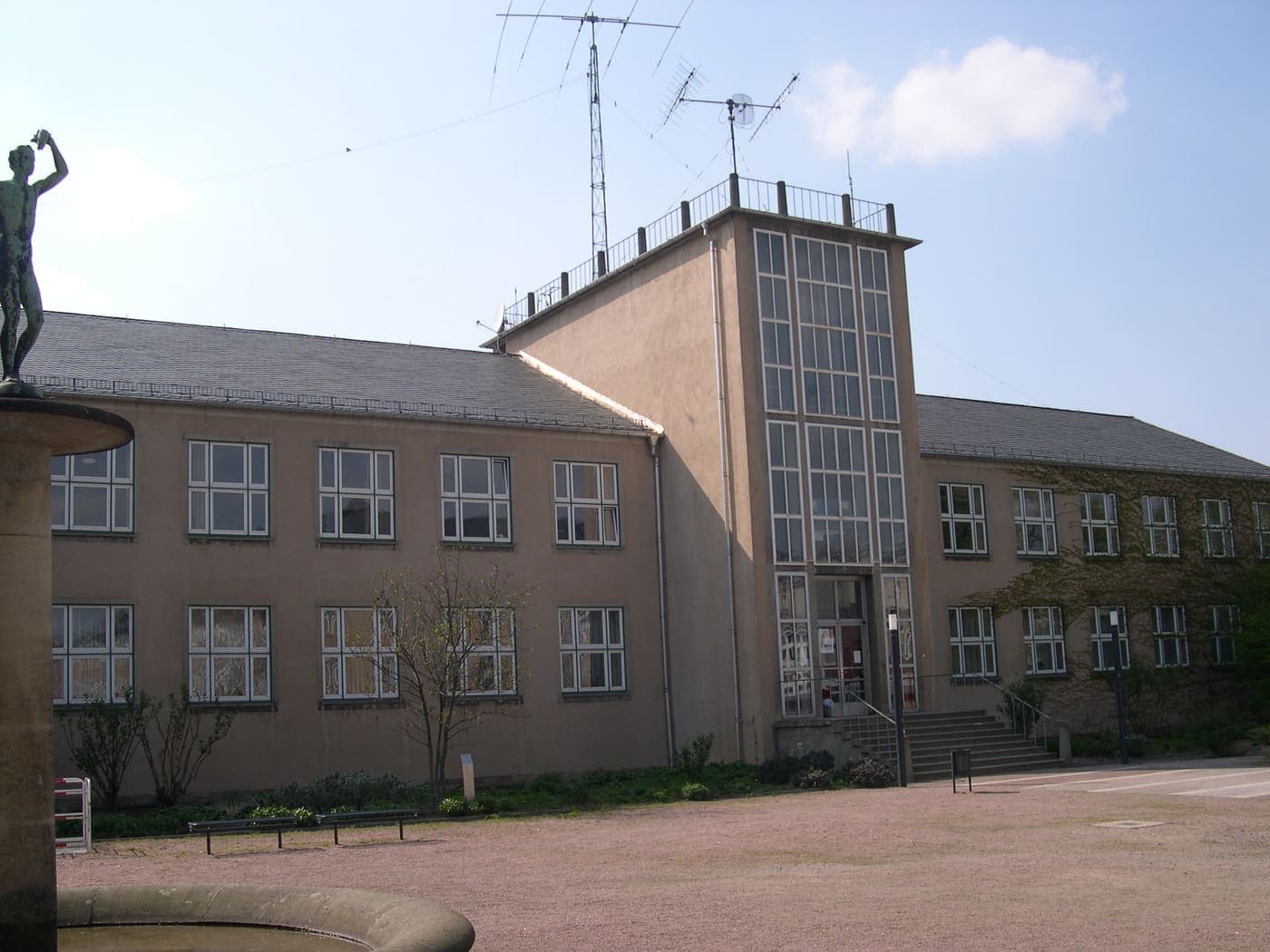
Photo credits: TU Dresden, Barkhausen-Bau by Hutschi, CC BY-SA 3.0. Via Wikimedia Commons. All image credits
