
University of Cologne (Universität zu Köln)
Quick Snapshot & Key Statistics
| Official Name | Universität zu Köln (University of Cologne) |
| Institution Type | Public Comprehensive Research University |
| Established | 1388 (Re-established in 1919; 6th oldest university in Central Europe) |
| Motto | Good designs arise from wisdom and courage (Sapientia et fortitudine) |
| Total Enrollment | ~47,000–50,000+ Students (~12% International Students from 130+ nations) |
| Academic Faculties | 6 Faculties | Over 200 Degree Programs |
| Institutional Affiliations | German U15, Coimbra Group, EUniWell (European University for Well-Being), CEMS |
| Main Location | Cologne (Köln), North Rhine-Westphalia (NRW), Germany |
| Global Rankings | Top 150–170 Worldwide (THE) | Top 10–12 in Germany |
| Tuition Fees (Regular Degrees) | €0 / year (100% Tuition-Free for all EU & non-EU international students) |
| Semester Contribution | ~€300 to €330 per semester (Includes administrative fees & nationwide transit pass) |
About University of Cologne
Founded in 1388, the University of Cologne (Universität zu Köln) is one of the oldest and largest universities in Europe. Re-established in 1919 by civic initiative, Cologne is a major research heavyweight in Economics, Business Administration, Molecular Genetics, Ageing Research (CECAD), Plant Sciences, Quantum Physics, and Behavioural Humanities.
Located in Cologne—Germany's fourth-largest city and cultural hub along the Rhine—the university operates an urban campus closely integrated into the city's Lindenthal district. It works alongside non-university research institutes, including three local Max Planck Institutes (Biology of Ageing, Metabolism Research, Plant Breeding Research), the German Aerospace Centre (DLR), and the EUniWell Alliance.
Why Choose University of Cologne?
- One of Germany's oldest universities
- Over 600 years of academic excellence
- One of Germany's largest public universities
- Strong international reputation
- Excellent research facilities
- Affordable public university education
- More than 300 degree programmes
- Numerous English-taught Master's programmes
- Strong industry and research collaborations
- Excellent graduate employability
Location & Campus Structure
The University of Cologne operates an integrated urban campus primarily located in the Lindenthal district in western Cologne:
- Central Campus (Albertus-Magnus-Platz): The academic core housing the Main Building (Hauptgebäude), the WiSo Faculty, Faculty of Law, Faculty of Arts and Humanities, and the University and City Library (USB).
- Medical Campus (Universitätsklinikum Köln): A high-tech clinical precinct hosting the Faculty of Medicine, University Hospital, and the CECAD Cluster of Excellence.
- Weyertal & STEM Hub: Located adjacent to the main campus, housing Physics, Chemistry, Computer Science, Geosciences, and the Cologne Biocenter.
Popular & Unique Degree Programs at University of Cologne
The University of Cologne is organised into 6 main academic faculties: the Faculty of Management, Economics and Social Sciences (WiSo Faculty), the Faculty of Law, the Faculty of Medicine (and University Hospital Cologne), the Faculty of Arts and Humanities, the Faculty of Mathematics and Natural Sciences, and the Faculty of Human Sciences (Education, Psychology, Special Education).
Top English-Taught Programs (International Favourites)
- M.Sc. Business Administration (Specialisations in Finance, Marketing, Corporate Development, Supply Chain Management, and Accounting & Taxation): Highly sought-after Master's degree hosted by the WiSo Faculty.
- CEMS Master in International Management (CEMS MIM): Elite international management degree offered exclusively in Germany by the University of Cologne WiSo Faculty.
- M.Sc. Business Analytics & Econometrics: Cutting-edge program merging data science, statistical modelling, machine learning, and quantitative economics.
- M.Sc. Computational Sciences: Interdisciplinary degree covering scientific computing, data analysis, and mathematical modelling.
- M.Sc. Genetics and Biology of Ageing and Regeneration: Specialised biomedical program closely integrated with the CECAD Cluster of Excellence.
- M.Sc. Experimental and Clinical Neuroscience: High-level medical research track bridging cellular neurobiology, cognitive neuroscience, and neurodegeneration.
- Double Master's Programs (e.g., Demography and Social Inequality, Health Economics and Management, Political Science): Joint international degrees operated with global partner universities.
Top German-Taught Degree Programs
- Human Medicine & Dentistry (Staatsexamen): Competitive clinical training program operated at the University Hospital Cologne (Universitätsklinikum Köln).
- Law (Rechtswissenschaft - Staatsexamen): One of Germany's largest and most traditional law faculties, offering comprehensive legal training and specialised binational law programs (LL.B./LL.M.).
- B.Sc. / M.Sc. Business Administration (Betriebswirtschaftslehre - BWL): Top-ranked undergraduate and graduate business degree with rigorous selection cutoffs (Numerus Clausus).
- B.Sc. Quantitative Biology: Elite interdisciplinary undergraduate program combining molecular biology, bioinformatics, and biophysics.
- B.Sc. / M.Sc. Psychology: High-demand program focusing on clinical, organisational, and cognitive psychology.
- Teacher Education Degrees (Lehramt - Master of Education): One of Germany's largest centres for teacher training across primary, secondary, and special needs education.
Language Requirements
Language prerequisites depend on the primary medium of instruction for your chosen program at the University of Cologne.
German Language Requirements (German-Taught Programs)
For degree programs taught in German, including all standard Bachelor's degrees and State Examination programs like Medicine, Dentistry, and Law, non-native applicants must prove C1 CEFR German proficiency:
- TestDaF: Minimum level of 4x4 (TDN 4 in all 4 examination sections).
- DSH: DSH-2 or DSH-3.
- telc: telc Deutsch C1 Hochschule.
- Goethe-Zertifikat: Goethe-Zertifikat C2.
English Language Requirements (English-Taught Programs)
For international Master's degree programs taught in English (e.g., Business Administration, Economics, Computational Sciences, Physics), applicants must submit proof of B2 or C1 CEFR English proficiency:
| IELTS Academic | Overall 6.5 or 7.0 (program-dependent) |
| TOEFL iBT | 88 to 100 points or higher |
| Cambridge English | C1 Advanced (CAE) or C2 Proficiency (CPE) |
| PTE Academic | 65 points or higher |
Fee Structure
As a public research university in North Rhine-Westphalia (NRW), University of Cologne does NOT charge tuition fees for standard Bachelor's or Master's degree programs for any student, regardless of citizenship.
Bachelor's Programmes
- Tuition Fee: No tuition fees
- Semester Contribution: Approximately €300–€330 per semester
Master's Programmes
- Tuition Fee: No tuition fees
- Semester Contribution: Approximately €300–€330 per semester
Mandatory Administrative & Living Costs
- Semester Contribution (Semesterbeitrag): ~€300 to €330 per semester (paid twice annually for re-registration).
- Blocked Account (Sperrkonto) for Visa: Non-EU international students must deposit €11,904 per year into an official Blocked Account to draw €992 per month for living costs.
- Monthly Living Costs in Cologne: Cologne is a major metropolitan centre. On average, students spend between €900 and €1,200 per month
Research & Industry Partnerships
University of Cologne collaborates with leading organisations and companies, including:
- Max Planck Society
- German Aerospace Centre (DLR)
- Research Centre Jülich
- Bayer
- Ford Germany
- Deutsche Telekom
- Lufthansa
- REWE Group
- EY
- PwC
These collaborations provide students with internships, research opportunities, consulting projects, and excellent graduate employment prospects.
Let's plan your path to studying at University of Cologne
From matching your profile to the right faculty to preparing a compelling application, our counsellors guide every step of your journey.
Frequently Asked Questions (FAQs)
The WiSo Faculty (Wirtschafts- und Sozialwissenschaftliche Fakultät) is one of Europe's largest and most famous faculties for management, economics, and social sciences. It holds international accreditations (such as EQUIS) and maintains a massive corporate recruitment network across Germany.
CECAD (Cellular Stress Responses in Aging-Associated Diseases) is an interdisciplinary Cluster of Excellence at Cologne. It investigates genetic and molecular mechanisms underlying cellular ageing, metabolic decline, neurodegeneration, and cancer.
ECONtribute: Markets & Public Policy is a joint Cluster of Excellence operated by the University of Cologne and the University of Bonn. It researches market design, financial regulation, social inequality, and economic policy intervention.
ML4Q is a joint Cluster of Excellence operated by the Universities of Cologne, Bonn, and Aachen alongside Forschungszentrum Jülich, focusing on building novel quantum hardware architectures and quantum computing materials.
Thanks to Cologne's status as a major economic centre home to media houses, pharmaceutical firms, logistics hubs, and consulting agencies, enrolled students can work up to 20 hours per week during term time as Werkstudenten. Typical hourly pay ranges from €15 to €22+ per hour, offering a direct pipeline to full-time employment.
EUniWell is an official European University alliance co-led by the University of Cologne alongside institutions like Florence, Birmingham, and Nantes, enabling joint online coursework and mobility exchanges centred on global societal well-being.
The WiSo Faculty at Cologne is the sole German member of CEMS (The Global Alliance in Management Education), allowing selected Master's students to complete a prestigious joint CEMS MIM degree alongside top global business schools.
Cologne hosts three Max Planck Institutes—MPI for Biology of Ageing, MPI for Metabolism Research, and MPI for Plant Breeding Research. University researchers co-staff labs and co-supervise international doctoral programs (IMPRS) with these institutes.
Standard Bachelor's degree programs at the University of Cologne are taught primarily in German and require certified C1 German proficiency. English-medium degrees are available mainly at the Master's and PhD levels.
Hochschulsport Köln offers over 100 sports disciplines, indoor fitness centres, swimming facilities, and outdoor recreation courses for enrolled students across Cologne.
Student dormitories are managed by Kölner Studierendenwerk (KSTW). Dorm rooms range from €300 to €500 per month. Due to high demand in Cologne, incoming students should apply for housing immediately upon receiving admission.
The university provides orientation programmes, academic advising, German language courses, accommodation guidance, career counselling, and dedicated international student services.
Choose University of Cologne if you are looking for a globally recognised public university with affordable education, outstanding research opportunities, excellent business and healthcare programmes, strong international partnerships, and exceptional career prospects. Its location in one of Germany's largest cities makes it an ideal destination for academic and professional success.
Explore Other Universities in Germany
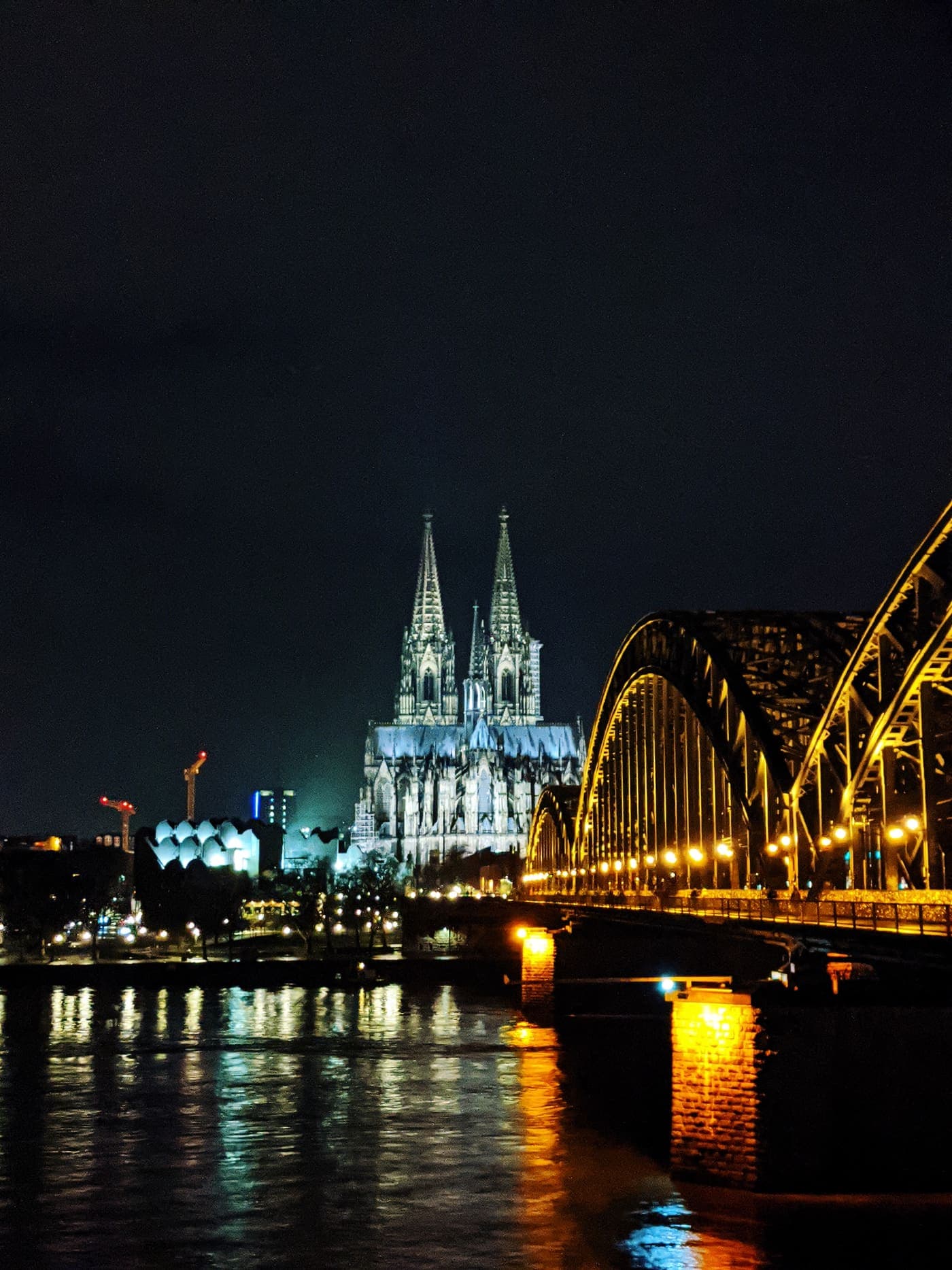
Photo credits: Cologne Cathedral on the Rhine by AtmikaPaul, CC BY-SA 4.0. Via Wikimedia Commons. All image credits
