
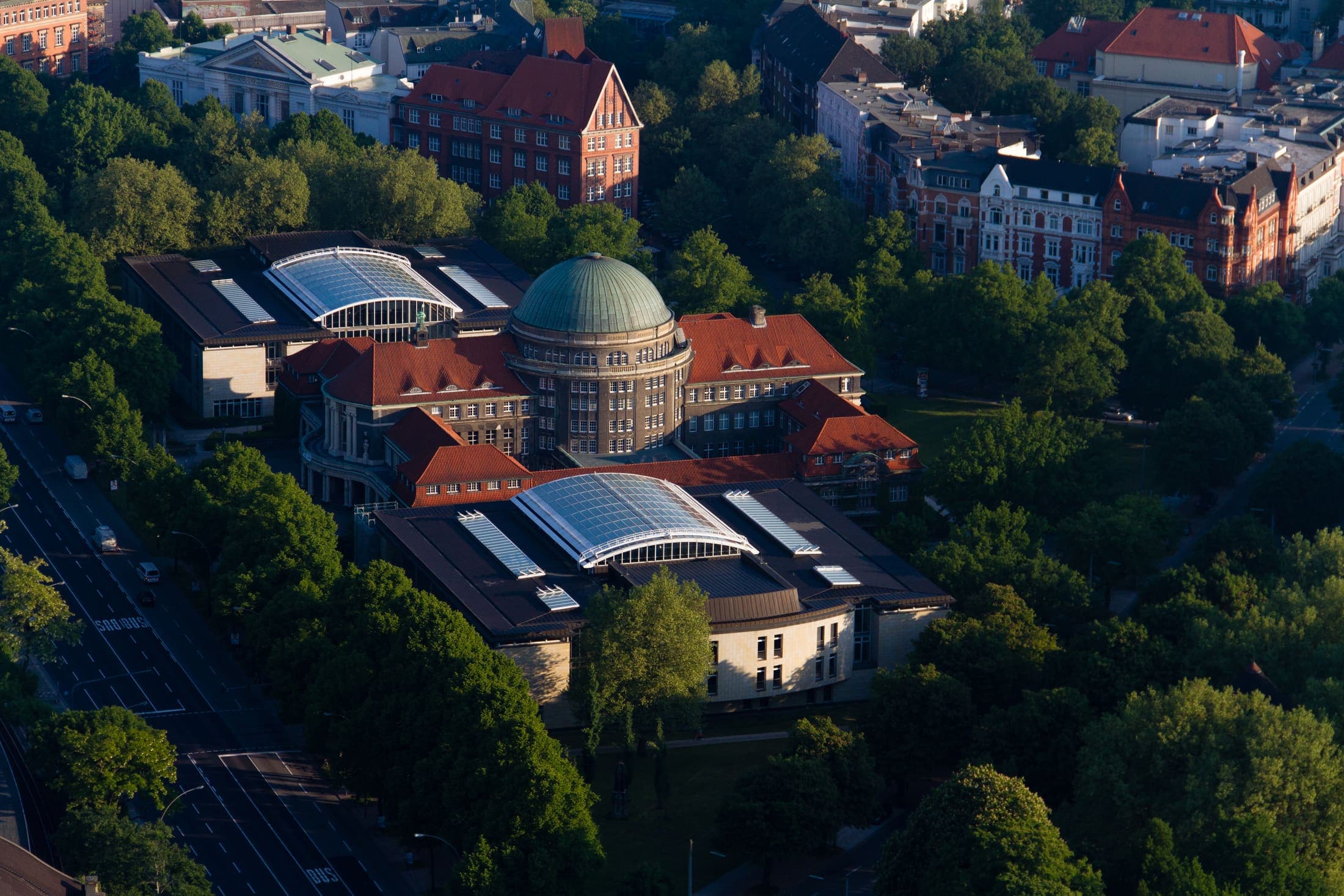
Universität Hamburg (UHH)
Quick Snapshot & Key Statistics
| Official Name | Universität Hamburg (UHH / University of Hamburg) |
| Institution Type | Public Comprehensive Research University / University of Excellence (Exzellenzuniversität) |
| Established | 1919 (Pioneered by Wilhelm Stern, Ernst Cassirer, and Albrecht Mendelssohn Bartholdy) |
| Motto | Der Forschung, der Lehre, der Bildung ("For research, for teaching, for education") |
| Total Enrollment | ~44,000+ Students (~12% International Students from 130+ countries) |
| Academic Faculties | 8 Faculties | Over 170 Degree Programs |
| Nobel Laureates | Associated with 7 Nobel Laureates (e.g., Otto Stern, Wolfgang Pauli, J. Hans D. Jensen) |
| Institutional Affiliations | German Excellence Strategy, German U15, European University Association, Campus Europae |
| Main Campus Location | Rotherbaum / Von-Melle-Park (Hamburg, Germany) |
| Tuition Fees (Regular Degrees) | €0 / year (100% Tuition-Free for all EU & non-EU international students) |
| Semester Contribution | ~€352 to €402 per semester (Includes administrative fee, welfare contribution, and transit ticket) |
About Universität Hamburg
Founded in 1919, Universität Hamburg (UHH) is the largest university in Northern Germany and one of the country's flagship higher education institutions. Officially recognised as a University of Excellence under Germany's national Excellence Strategy, UHH is renowned for its interdisciplinary leadership in Climate and Earth System Research, Photon & Nanosciences, Quantum Physics, Manuscript Sciences, and Life Sciences.
As a comprehensive Volluniversität, UHH maintains deep scientific networks with non-university research giants, including DESY (Deutsches Elektronen-Synchrotron), the Max Planck Institute for Meteorology, the European XFEL, and the Bernhard Nocht Institute for Tropical Medicine.
Why Choose Universität Hamburg?
- Member of Germany's Universities of Excellence
- One of Germany's largest public research universities
- Strong reputation in research and innovation
- Wide range of academic disciplines
- Affordable public university education
- Excellent research facilities
- Numerous English-taught Master's programmes
- International campus with students from over 130 countries
- Strong industry and research collaborations
- Excellent graduate employability
Location & Campus Structure of Universität Hamburg
Universität Hamburg operates as an urban, integrated city university spread across several key neighbourhood hubs in the city-state of Hamburg:
- Rotherbaum / Von-Melle-Park (Central Campus): Located near the Dammtor railway station in central Hamburg. Houses the iconic Audimax, the Main Building (Hauptgebäude), the State and University Library (SUB Carl von Ossietzky), and the Faculties of Humanities, Law, Business, Economics, Social Sciences, and Education.
- Science City Hamburg Bahrenfeld: Located in western Hamburg. Houses the Department of Physics, photon science research centres, particle accelerators, and the joint research facilities with DESY and the European XFEL.
- Campus Eppendorf: Home to the University Medical Centre Hamburg-Eppendorf (UKE), one of Northern Europe's leading university hospitals for clinical medicine, neuroscience, and oncology.
- Campus Klein Flottbek & Stellingen: Houses the Department of Biology, Loki Schmidt Garden, and the Department of Computer Science.
Popular & Unique Degree Programs
Universität Hamburg offers over 170 degree programs across 8 academic faculties: Faculty of Law, Faculty of Business, Economics and Social Sciences, Faculty of Medicine, Faculty of Education, Faculty of Humanities, Faculty of Mathematics, Informatics and Natural Sciences (MIN), Faculty of Psychology and Human Movement Science, and Faculty of Business Administration (Hamburg Business School).
Specialised English-Taught Master's Programs
- M.Sc. Integrated Climate System Sciences (ICSS): World-class interdisciplinary program hosted at the School of Integrated Climate System Sciences (SICSS), combining physical climate science, economics, and social dynamics.
- M.Sc. Intelligent Adaptive Systems (IAS): Advanced artificial intelligence and robotics track focusing on machine learning, neural networks, and autonomous agents.
- M.Sc. Physics / Mathematical Physics: Advanced research track in particle physics, quantum optics, astrophysics, and solid-state physics linked with DESY.
- M.Sc. Industrial Mathematics: Focuses on mathematical modelling, scientific computing, and optimisation for industrial technologies.
- M.A. Manuscript Cultures: World-exclusive program hosted by the Centre for the Study of Manuscript Cultures (CSMC), studying handwritten artefacts from antiquity to the digital age.
- M.Sc. Molecular Life Sciences: Cutting-edge cellular biology, biochemistry, and structural systems biology.
Language Requirements (English & German)
Language requirements depend on the medium of instruction for your specific program at Universität Hamburg.
German Language Requirements (German-Taught Programs)
For degree programs taught in German (including standard Bachelor's degrees and State Examination programs), non-native applicants must prove C1 CEFR German proficiency:
- TestDaF: Minimum of 4x4 (TDN 4 in all 4 examination sections).
- DSH: DSH-2 or DSH-3.
- telc: telc Deutsch C1 Hochschule.
- Goethe-Zertifikat: Goethe-Zertifikat C1 or C2.
English Language Requirements (English-Taught Programs)
For internationally oriented Bachelor's and Master's degree programs taught in English, applicants must submit proof of B2 or C1 CEFR English proficiency:
| IELTS Academic | Overall 6.5 or 7.0 (program-dependent; min. 5.5–6.0 per subscore) |
| TOEFL iBT | 85 to 100 points or higher |
| Cambridge English | C1 Advanced (CAE) or C2 Proficiency (CPE) |
| PTE Academic | 59 to 65 points or higher |
Fee Structure at Universität Hamburg
As a public research university in the state of Hamburg, Universität Hamburg does NOT charge tuition fees for standard Bachelor's, Master's, or Doctoral degree programs for any student, regardless of citizenship.
Bachelor's Programmes
- Tuition Fee: No tuition fees
- Semester Contribution: Approximately €352 to €402 per semester
Master's Programmes
- Tuition Fee: No tuition fees
- Semester Contribution: Approximately €352 to €402 per semester
Mandatory Administrative & Living Costs at Universität Hamburg
- Semester Contribution (Semesterbeitrag): ~€352 to €402 per semester (paid twice a year for re-registration).
- Blocked Account (Sperrkonto) for Visa: Non-EU international students must deposit €11,904 per year into an official Blocked Account to draw €992 per month for living expenses.
- Monthly Living Costs in Hamburg: Hamburg is a major metropolitan centre. On average, students spend between €950 and €1,300 per month.
Research & Industry Partnerships
Universität Hamburg collaborates with leading research institutions and companies, including:
- DESY (German Electron Synchrotron)
- Max Planck Society
- Helmholtz Association
- Airbus
- Lufthansa Technik
- Beiersdorf
- Otto Group
- IBM
- NXP Semiconductors
These collaborations provide students with research opportunities, internships, innovation projects, and excellent career prospects.

Let's plan your path to studying at Universität Hamburg
From matching your profile to the right faculty to preparing a compelling application, our counsellors guide every step of your journey.
Frequently Asked Questions (FAQs)
In 2019, Universität Hamburg was awarded the status of University of Excellence under the German Excellence Strategy for its "Flagship University" institutional concept. This status provides UHH with long-term federal and state funding to expand international research, hire top global faculty, and establish strategic research alliances.
UHH hosts four interdisciplinary Clusters of Excellence: CLICCS (Climate, Climatic Change, and Society); CUI, Advanced Imaging of Matter (Photons, nanosciences, and atomic dynamical control); Quantum Universe (Particle physics, dark matter, and gravitational waves); and Understanding Written Artefacts (UWA / CSMC), covering manuscript research across global cultures from antiquity to the digital age.
Science City Hamburg Bahrenfeld is a massive urban science infrastructure project integrating UHH's physics and chemistry departments with DESY (Deutsches Elektronen-Synchrotron) and the European XFEL. It provides UHH researchers and students with access to high-brilliance X-ray sources, particle accelerators, and specialised quantum research centres like the HAFUN building.
Medical education and healthcare research are conducted at the University Medical Centre Hamburg-Eppendorf (UKE). UKE is an integrated university hospital renowned for its research in neurosciences, cardiovascular disease, oncology, and tropical medicine in cooperation with the Bernhard Nocht Institute.
The Centre for the Study of Manuscript Cultures (CSMC) at UHH is a world-unique research hub that combines humanities, computer science, and natural sciences such as archaeometry and particle physics to analyse physical manuscripts, cuneiform tablets, and historical written artefacts without damaging them.
CLICCS (Climate, Climatic Change, and Society) evaluates the plausibility of various climate futures by modelling ocean dynamics, Arctic permafrost thawing, atmospheric science, socio-economic policy, and climate mitigation strategies.
Operated jointly by UHH and DESY, Quantum Universe explores the fundamental connection between particle physics, dark matter, gravitational waves, and quantum gravity. It connects theoretical mathematical physics with big-data gravitational wave experiments.
CUI brings together over 180 researchers in physics, chemistry, and structural biology to observe and control the movement of atoms and molecules in real time, enabling the design of novel functional materials and quantum systems.
The historic central campus is located in the Rotherbaum district around Von-Melle-Park. It houses the iconic neo-Baroque Main Building (Hauptgebäude), the Audimax lecture hall, the State Library, and the central administrative offices.
Yes. UHH offers specialised international graduate tracks like the M.Sc. Ocean and Climate Physics and M.Sc. Integrated Climate System Sciences (ICSS), leveraging Hamburg's position as a maritime research hub and its partnership with the Max Planck Institute for Meteorology.
STiNE (Studien-Informations-Netzwerk) is UHH's central online portal. Students use STiNE to register for courses, manage module exams, view grade transcripts, access official university notifications, and download semester fee payment forms.
The Asia-Africa Institute (AAI) at UHH's Faculty of Humanities is one of Europe's largest centres for regional and cultural studies, specialising in Indology, Sinology, Ethiopian Studies, Japanese Studies, and Islamic Studies.
PIER (Partnership for Innovation, Education and Research) is an official strategic alliance between Universität Hamburg and DESY. PIER operates dedicated graduate schools, joint professorships, and seed funding in infection and structural biology, photon science, particle physics, and accelerator research.
The ZNF (Centre for Science and Peace Research) at UHH is an interdisciplinary research center that applies natural science and technical methods to nuclear disarmament, verification of arms control treaties, cyber security, and international conflict resolution.
Universität Hamburg is an excellent choice for students seeking a globally recognised degree, affordable public education, world-class research opportunities, and strong career prospects. Its location in Hamburg, one of Europe's major economic and cultural centres, offers exceptional opportunities for academic, personal, and professional growth.
Explore Other Universities in Germany
Photo credits: Container terminal, Port of Hamburg by Raimond Spekking, CC BY-SA 4.0. Via Wikimedia Commons. All image credits
