
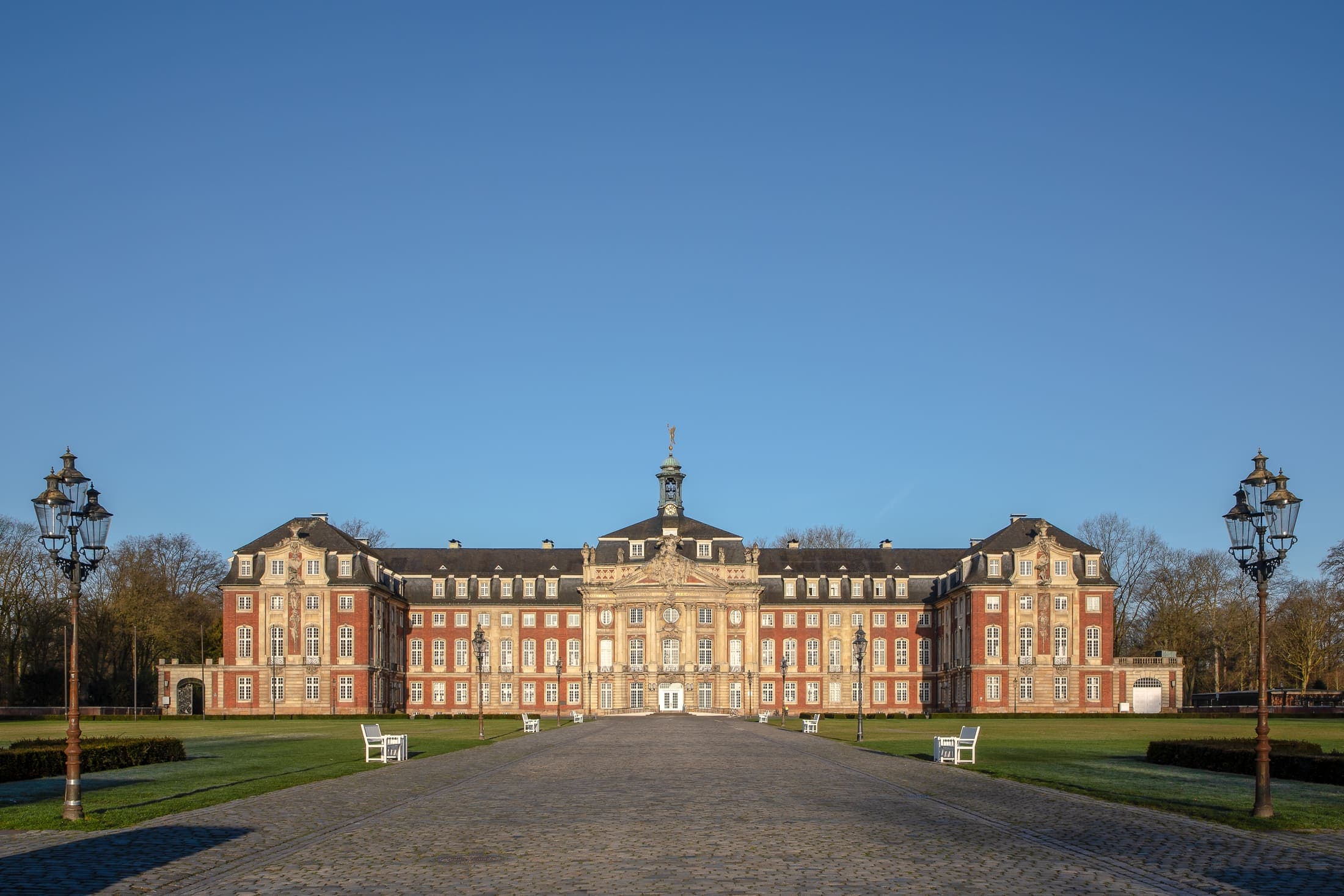
University of Münster (Universität Münster)
Quick Snapshot & Key Statistics
| Official Name | Universität Münster (University of Münster / formerly Westfälische Wilhelms-Universität Münster) |
| Institution Type | Public Comprehensive Research University |
| Established | 1780 (Founded by Prince-Bishop Maximilian Friedrich von Königsegg-Rothenfels) |
| Motto | wissen.leben ("Living Knowledge") |
| Total Enrollment | ~45,000+ Students (~3,500+ International Students from 120+ nations) |
| Academic Faculties | 15 Academic Faculties | Over 120 Subjects & 280 Degree Programs |
| Excellence Status | 2 Clusters of Excellence: "Religion and Politics" & "Mathematics Münster" |
| Nobel Laureates | Associated with 2 Nobel Laureates (Gerhard Domagk, Johannes Georg Bednorz) |
| Institutional Affiliations | German U15, European University Association (EUA), Ulysseus European University |
| Main Location | Münster, North Rhine-Westphalia (NRW), Germany |
| Global Rankings | Ranked Top 190–220 Worldwide (THE/US News) | Top 15 in Germany |
| Tuition Fees (Regular Degrees) | €0 / year (100% Tuition-Free for all EU & non-EU international students) |
| Semester Contribution | ~€369.50 per semester (Includes administrative fees, student services & nationwide Deutschlandticket) |
About University of Münster
Founded in 1780, the University of Münster (Universität Münster) is one of Germany's largest, most prestigious public research universities. Known for its interdisciplinary research strength spanning the humanities, social sciences, medicine, and natural sciences, Münster is an academic powerhouse hosting two national Clusters of Excellence: "Religion and Politics" and "Mathematics Münster: Dynamics - Geometry - Structure".
Embedded across the city of Münster—widely recognised as Germany's "Bicycle Capital" (Fahrradstadt) and one of Europe's most liveable cities—the university shapes every aspect of urban life, with students accounting for roughly 20% of the city's population. Münster maintains extensive scientific partnerships with the Max Planck Institute for Molecular Biomedicine, the Helmholtz Institute Münster (HI MS / IEK-12) for battery research, and the European Research Centre for Information Systems (ERCIS).
Why Choose University of Münster?
- One of Germany's largest public universities
- Strong international reputation
- 15 faculties covering diverse academic disciplines
- Excellent research facilities
- Affordable public university education
- Wide range of Bachelor's and Master's programmes
- Numerous English-taught Master's programmes
- Strong international partnerships
- Excellent graduate employability
- Student-friendly and safe city
Location & Campus Structure of University of Münster
Unlike traditional single-site campuses, the University of Münster is integrated into the city fabric, occupying over 200 university buildings across four primary district hubs in Münster, North Rhine-Westphalia:
- Schloss Campus (Central City Hub): Centred on the historic Residenzschloss Münster (the former Prince-Bishops' Palace). Houses University Administration, central auditoriums, and nearby facilities for Law, Economics, Humanities, Social Sciences, Theology, and the University and State Library (ULB).
- Coesfelder Kreuz Campus (Natural Sciences Hub): A modern STEM research zone in western Münster housing the Faculties of Mathematics & Computer Science, Physics, Chemistry & Pharmacy, Biology, the MEET Battery Research Centre, and the CiM Interfaculty Centre.
- Medical Campus (Universitätsklinikum Münster - UKM): Situated around Domagkstraße, hosting the Faculty of Medicine, specialised clinical research suites, and the Max Planck Institute for Molecular Biomedicine.
- GEO Campus (Heisenbergstraße): A dedicated centre for Geoinformatics, Spatial Data Science, Geography, and Earth Sciences.
Popular & Unique Degree Programs
University of Münster offers more than 280 degree programmes across 15 faculties, with many Master's programmes available in English, while most Bachelor's programmes are taught primarily in German.
Top English-Taught Master's Programs (International Favourites)
- M.Sc. Information Systems: World-renowned graduate degree offered by the European Research Centre for Information Systems (ERCIS) and the School of Business & Economics.
- M.Sc. Geoinformatics and Spatial Data Science: Top European program in geospatial modelling, remote sensing, spatial AI, and GI science.
- M.Sc. Mathematics Münster: Elite program tied directly to the Mathematics Münster Cluster of Excellence, covering pure analysis, geometry, and topology.
- M.Sc. Physics / M.Sc. Geophysics: Research-intensive degrees leveraging local supercomputing clusters and specialised laboratory facilities.
- M.Sc. Sports, Exercise and Human Performance: Advanced research track bridging human movement science, biomechanics, and exercise physiology.
- M.A. National and Transnational Studies (NTS): Interdisciplinary humanities track examining Anglophone literatures, postcolonial culture, and global linguistics.
- M.Sc. Comparative Public Governance: Dual-degree international program operated jointly with the University of Twente (Netherlands).
Top German-Taught Degree Programs
- Human Medicine & Dentistry (Staatsexamen): Highly competitive, world-class medical training operated at the University Hospital Münster (UKM).
- Law (Rechtswissenschaft - Staatsexamen / LL.M.): One of Germany's largest and highest-ranked law faculties, known for corporate law, tax law, and IT law.
- B.Sc. / M.Sc. Business Administration (Betriebswirtschaftslehre - BWL): Consistently ranked among Germany's top 3 business administration degrees at the School of Business & Economics.
- B.Sc. / M.Sc. Psychology: Highly sought-after program with strong research emphasis on cognitive, clinical, and organisational psychology.
- B.Sc. / M.Sc. Chemistry / Food Chemistry: High-demand chemical research program linked to the MEET Battery Research Centre.
- Teacher Education Degrees (Lehramt - Master of Education): Major regional centre for teacher training across all school levels.
Language Requirements (English & German)
Language prerequisites depend on the primary medium of instruction for your chosen program at the University of Münster.
German Language Requirements (German-Taught Programs)
For degree programs taught in German, including standard Bachelor's degrees and State Examination programs like Medicine, Dentistry, and Law, non-native applicants must prove C1 CEFR German proficiency:
- DSH: DSH-2 or DSH-3.
- TestDaF: Minimum level of 4x4 (TDN 4 in all 4 examination sections).
- telc: telc Deutsch C1 Hochschule.
- Goethe-Zertifikat: Goethe-Zertifikat C2.
English Language Requirements (English-Taught Programs)
For international Bachelor's and Master's degree programs taught in English, applicants must submit proof of B2 or C1 CEFR English proficiency:
| IELTS Academic | Overall 6.5 or 7.0 (program-dependent) |
| TOEFL iBT | 88 to 100 points or higher |
| Cambridge English | C1 Advanced (CAE) or C2 Proficiency (CPE) |
| PTE Academic | 62 to 65 points or higher |
Fee Structure at University of Münster
As a public research university in North Rhine-Westphalia (NRW), University of Münster does NOT charge tuition fees for standard Bachelor's, Master's, or Doctoral degree programs for any student, regardless of citizenship.
Bachelor's Programmes
- Tuition Fee: No tuition fees
- Semester Contribution: Approximately €369 per semester
Master's Programmes
- Tuition Fee: No tuition fees
- Semester Contribution: Approximately €369 per semester
Mandatory Administrative & Living Costs at University of Münster
- Semester Contribution (Semesterbeitrag): ~€369.50 per semester (paid twice annually for re-registration).
- Blocked Account (Sperrkonto) for Visa: Non-EU international students must deposit €11,904 per year into an official Blocked Account to draw €992 per month for living costs.
- Monthly Living Costs in Münster: Münster is an affordable, comfortable student town. On average, students spend between €850 and €1,050 per month.
Research & Industry Partnerships
University of Münster collaborates with leading organisations and companies, including:
- Max Planck Society
- Fraunhofer Society
- Leibniz Association
- BASF
- Bayer
- Evonik
- NRW Research Network
- University Hospital Münster
- Forschungszentrum Jülich
- Sparkasse Group
These collaborations provide students with research opportunities, internships, innovation projects, and excellent graduate employment prospects.
Let's plan your path to studying at University of Münster
From matching your profile to the right faculty to preparing a compelling application, our counsellors guide every step of your journey.
Frequently Asked Questions (FAQs)
The University of Münster offers good part-time job opportunities in IT, finance, healthcare, and business. Students can generally work up to 20 hours per week during the semester, with many Werkstudent positions paying €15–€22+ per hour and providing valuable industry experience.
The Cluster of Excellence "Religion and Politics: Dynamics of Tradition and Innovation" is Germany's largest humanities and social sciences research cluster. It investigates the historic and contemporary interplay between religious systems, political authority, social cohesion, and secular law across global cultures.
Mathematics Münster: Dynamics – Geometry – Structure is an internationally acclaimed Cluster of Excellence. It unites research groups across pure and applied mathematics to solve fundamental problems in geometric analysis, algebraic topology, and probability theory.
ERCIS is an international research network centred at the University of Münster. It bridges computer science, business administration, and digital engineering to research enterprise architecture, process management, AI applications, and e-government.
The MEET (Münster Electrochemical Energy Technology) Battery Research Centre is a leading international energy storage research facility at Münster. It works alongside the Helmholtz Institute Münster (HI MS) to develop next-generation lithium-ion, solid-state, and sustainable battery technologies for electric vehicles and renewable energy grids.
Münster has more bicycles than residents (over 500,000 bikes for 320,000 inhabitants). The city features the Promenade—a green, car-free ring road around the old town—allowing students to travel between all university faculties, libraries, and dormitories easily on foot or by bike.
Located close to the Dutch border, Münster maintains strategic cross-border academic programs with the University of Twente (Enschede), including joint Master's degrees in Comparative Public Governance and European Studies.
The Universitäts- und Landesbibliothek Münster (ULB) holds over 6 million volumes and serves as both the central academic library for students and the regional legal deposit library for Westphalia, featuring 24/7 digital resource access and learning zones.
Included in the semester fee (~€369.50) is the Deutschlandticket, allowing unlimited public transit across all of Germany, plus a local Culture Ticket offering free or heavily discounted entry to Münster theatres, museums, and concerts.
The MPI for Molecular Biomedicine operates in close partnership with the university's biological and medical faculties, conducting cutting-edge research on stem cell biology, vascular development, and regenerative medicine.
Studierendenwerk Münster manages over 20 student residence halls across the city. Room rents range from €300 to €450 per month including utilities. Due to high demand in Münster, incoming students are strongly advised to apply for housing immediately upon receiving admission.
Explore Other Universities in Germany
Photo credits: Düsseldorf skyline by QuidoX, CC BY-SA 3.0. Via Wikimedia Commons. All image credits
