
University of Stuttgart (Universität Stuttgart)
Quick Snapshot & Key Statistics
| Official Name | Universität Stuttgart (University of Stuttgart) |
| Institution Type | Public Technical Research University (Technische Universität) |
| Established | 1829 (Founded as Vereinigte Real- und Gewerbeschule) |
| Motto | Mind and Technology (Geist und Technik) |
| Total Enrollment | ~20,500–22,000+ Students (~23% International Students from 120+ nations) |
| Academic Faculties | 10 Faculties | Over 150 Degree Programs |
| Excellence Status | 2 Clusters of Excellence: SimTech (Data-Integrated Simulation Science) & IntCDC (Computational Design and Construction) |
| Institutional Affiliations | TU9 (Alliance of Leading German Institutes of Technology), CESAER, TIME, PEGASUS |
| Main Location | Stuttgart, Baden-Württemberg, Germany |
| Global Rankings | Top 300–320 Worldwide (QS World University Rankings) | Top 15 in Germany |
| Tuition Fees (Non-EU) | €1,500 per semester (~€3,000 / year under Baden-Württemberg state law) |
| Tuition Fees (EU/EEA) | €0 / year (Tuition-Free for EU/EEA citizens) |
| Semester Contribution | ~€200 to €220 per semester (Administrative & student welfare fees) |
About University of Stuttgart
Founded in 1829, the University of Stuttgart (Universität Stuttgart) is one of Germany's oldest and most renowned technical universities. As a flagship member of the TU9 Alliance—the coalition of Germany's nine leading technological institutes—the university is internationally celebrated for engineering, simulation technology, automotive engineering, computer science, and architecture.
Located in Stuttgart, the capital of Baden-Württemberg and the industrial heartland of Europe, the university benefits from direct integration into a high-tech corporate and research landscape. It operates in proximity to major industrial headquarters—including Mercedes-Benz, Porsche, Bosch, Mahle, and IBM—as well as non-university scientific centres like the Fraunhofer Institutes, Max Planck Institutes, and the German Aerospace Centre (DLR).
Why Choose University of Stuttgart?
- One of Germany's leading engineering universities
- Member of the prestigious TU9 Alliance
- Strong international reputation
- Excellent research facilities
- Close partnerships with global industries
- Affordable public university education
- Wide range of English-taught Master's programmes
- Outstanding internship and research opportunities
- Modern laboratories and innovation centres
- Excellent graduate employability
Location & Campus Structure of University of Stuttgart
The University of Stuttgart is divided into two primary campus hubs connected by direct S-Bahn transit (approx. 10 minutes apart):
- Campus Stadtmitte (City Centre): Located in central Stuttgart near the main train station (Hauptbahnhof). Houses the historic main buildings, the central library, and the Faculties of Architecture & Urban Planning, Civil & Environmental Engineering, Humanities, and Management, Economics & Social Sciences.
- Campus Vaihingen (Suburban Science City): A modern, green high-tech campus surrounded by forest in the suburb of Vaihingen. Houses the major engineering and science faculties: Computer Science, Electrical Engineering, Aerospace Engineering, Mechanical Engineering, Chemistry, Physics, Mathematics, the High-Performance Computing Centre (HLRS), and student dorms.
Popular & Unique Degree Programs
The University of Stuttgart is organised into 10 main academic faculties: Architecture and Urban Planning, Civil and Environmental Engineering, Chemistry and Materials Science, Energy-, Process- and Bio-Engineering, Computer Science, Electrical Engineering and Information Technology, Aerospace Engineering and Geodesy, Engineering Design, Production Engineering and Automotive Engineering, Mathematics and Physics, Humanities, and Management, Economics and Social Sciences. Each of these primary faculties contains internal sub-structures, such as specialised research institutes, subject departments, doctoral centres, and specific degree tracks.
Top English-Taught Programs (International Favourites)
- M.Sc. COMMAS (Computational Mechanics of Materials and Structures): World-renowned program in computational continuum mechanics, finite element methods, and structural analysis.
- M.Sc. Information Technology (INFOTECH): Interdisciplinary program bridging computer hardware, embedded systems, communication networks, and signal processing.
- M.Sc. Integrated USiE (Urban Sciences and Infrastructure Engineering): Focuses on sustainable infrastructure, smart cities, and environmental urban engineering.
- M.Sc. GEOENGINE (Geodesy and Geoinformatics): High-precision satellite positioning, geospatial analytics, and remote sensing.
- M.Sc. Computational Linguistics: Advanced natural language processing (NLP), speech processing, and computational semantics.
- M.Sc. WAREM (Water Resources Engineering and Management): International environmental engineering track covering hydraulic modelling, groundwater management, and water quality.
Top German-Taught Degree Programs
- B.Sc. / M.Sc. Automotive and Engine Technology (Fahrzeug- und Motorentechnik): Globally famous automotive engineering program with direct ties to Porsche, Mercedes-Benz, and Bosch.
- B.Sc. / M.Sc. Aerospace Engineering (Luft- und Raumfahrttechnik): One of Europe's largest aerospace engineering departments.
- B.Sc. / M.Sc. Computer Science (Informatik): Top-ranked computer science department specialising in software engineering, AI, and graphics.
- B.Sc. / M.Sc. Architecture and Urban Planning (Architektur und Stadtplanung): Renowned program emphasising digital fabrication, biomimetics, and lightweight construction.
- B.Sc. / M.Sc. Mechanical Engineering (Maschinenbau): Traditional German engineering degree with comprehensive industrial specialisation options.
Language Requirements (English & German)
Language prerequisites depend on the primary medium of instruction for your degree program at the University of Stuttgart.
German Language Requirements (German-Taught Programs)
For degree programs taught in German (including standard Bachelor's degrees and many Master's tracks), non-native applicants must prove C1 CEFR German proficiency:
- TestDaF: Minimum level of 4x4 (TDN 4 in all 4 examination sections).
- DSH: DSH-2 or DSH-3.
- telc: telc Deutsch C1 Hochschule.
- Goethe-Zertifikat: Goethe-Zertifikat C2.
English Language Requirements (English-Taught Programs)
For international Master's degree programs taught in English, applicants must submit proof of B2 or C1 CEFR English proficiency:
| IELTS Academic | Overall 6.5 or 7.0 (program-dependent) |
| TOEFL iBT | 88 to 95 points or higher |
| Cambridge English | C1 Advanced (CAE) or C2 Proficiency (CPE) |
| PTE Academic | 65 points or higher |
Fee Structure at University of Stuttgart
Because the University of Stuttgart is located in the state of Baden-Württemberg, state legislation mandates tuition fees for international students from non-EU/EEA countries enrolled in standard degree programs.
Bachelor's Programmes
- EU/EEA Students: No tuition fees
- Non-EU Students: €1,500 per semester (for most degree programmes)
- Semester contribution: Approximately €200–€220 per semester
Master's Programmes
- Consecutive Master's Programmes — EU/EEA Students: No tuition fees
- Consecutive Master's Programmes — Non-EU Students: €1,500 per semester (for most programmes)
- Semester contribution: Approximately €200–€220 per semester
Mandatory Administrative & Living Costs at University of Stuttgart
- Semester Contribution (Semesterbeitrag): ~€200 to €220 per semester (paid twice annually for re-registration).
- Tuition Fee (Non-EU Students): €1,500 per semester.
- Blocked Account (Sperrkonto) for Visa: Non-EU international students must deposit €11,904 per year into an official Blocked Account to draw €992 per month for living costs.
- Monthly Living Costs in Stuttgart: Stuttgart is an economically thriving industrial city. On average, students spend between €900 and €1,200 per month.
Research & Industry Partnerships
University of Stuttgart collaborates with leading companies and research organisations, including:
- Mercedes-Benz Group
- Porsche
- Bosch
- Siemens
- IBM
- Airbus
- Mahle
- Fraunhofer Society
- Max Planck Society
- German Aerospace Centre (DLR)
These partnerships provide students with internships, research projects, innovation initiatives, and strong graduate employment prospects.
Let's plan your path to studying at University of Stuttgart
From matching your profile to the right faculty to preparing a compelling application, our counsellors guide every step of your journey.
Frequently Asked Questions (FAQs)
Thanks to Stuttgart's high concentration of global engineering corporations such as Mercedes-Benz, Porsche, Bosch, Mahle, IBM and research centres like Fraunhofer, DLR, and university institutes, students have exceptional access to Werkstudent positions. Werkstudent jobs in engineering, IT, and business in Stuttgart pay competitive hourly wages (typically €15 to €22+ per hour) and frequently lead directly to Master's thesis sponsorships and graduate job offers.
SimTech (Data-Integrated Simulation Science) is a Cluster of Excellence researching advanced computer simulation methods. It combines traditional engineering modelling with data science and machine learning to simulate complex physical systems, mechanics, biomechanics, and materials.
IntCDC (Integrative Computational Design and Construction for Transformative Architecture) is a Cluster of Excellence uniting architecture, civil engineering, computer science, and robotics. It researches digital design methods, robotic prefabrication, bio-based fibre building materials, and sustainable construction techniques.
HLRS (Höchstleistungsrechenzentrum Stuttgart) is a German national supercomputing centre located at Campus Vaihingen. It houses petascale and exascale supercomputers such as Hawk used by university researchers and industrial partners for aerodynamic simulation, climate modelling, and quantum computing simulations.
ARENA2036 (Active Research Environment for the Next Generation of Automobiles) is a flexible research facility on Campus Vaihingen. It brings together university professors, PhD researchers, and engineers from industrial partners like Mercedes-Benz and BASF to work side-by-side on lightweight materials, digital manufacturing, and future automotive production lines.
The DLR (Deutsches Zentrum für Luft- und Raumfahrt) operates several major research institutes adjacent to Campus Vaihingen, focusing on solar research, space systems, combustion technology, and structures. DLR researchers teach university modules and co-supervise student research projects.
stuvus (Studierendenvertretung Universität Stuttgart) is the official, democratic student union representation at the university. It organises student events, manages campus initiatives, provides legal/social advice, and represents student interests across university boards.
This interdisciplinary initiative connects robotics, control engineering, computer vision, and machine learning to develop autonomous vehicles, industrial robots, and self-navigating drone systems.
The ICD, led by Prof. Achim Menges, is a world-famous architectural research institute at Stuttgart known for pioneering pavilion structures built with robotic fibre winding, self-shaping timber, and bio-inspired material architectures.
The University Library (UB Stuttgart) operates two main branches: UB Stadtmitte specialising in humanities, economics, and architecture and UB Vaihingen specialising in science and engineering. It provides 24/7 digital resource access, group study hubs, and high-tech Makerspaces.
VISUS (Visualisation Research Centre) is an institute dedicated to scientific data visualisation, visual analytics, computer graphics, and augmented/virtual reality (AR/VR) applications for complex scientific data.
Yes. Under Baden-Württemberg state law, registered doctoral candidates at the University of Stuttgart are exempt from the €1,500 per semester non-EU tuition fee and pay only the standard administrative semester contribution (~€200–€220).
The University of Stuttgart operates advanced aerodynamic testing facilities, including full-scale aeroacoustic wind tunnels used for automotive aerodynamic research and vehicle thermal management testing.
Yes. The University of Stuttgart is a key academic partner in Cyber Valley—Europe's largest AI research consortium—alongside the University of Tübingen, the Max Planck Institute for Intelligent Systems, and corporate partners like Bosch and Mercedes-Benz.
AHS (Allgemeiner Hochschulsport) offers over 100 sports disciplines, fitness centres, climbing walls, and outdoor recreation courses across both the Vaihingen and Stadtmitte campuses for enrolled students.
Explore Other Universities in Germany
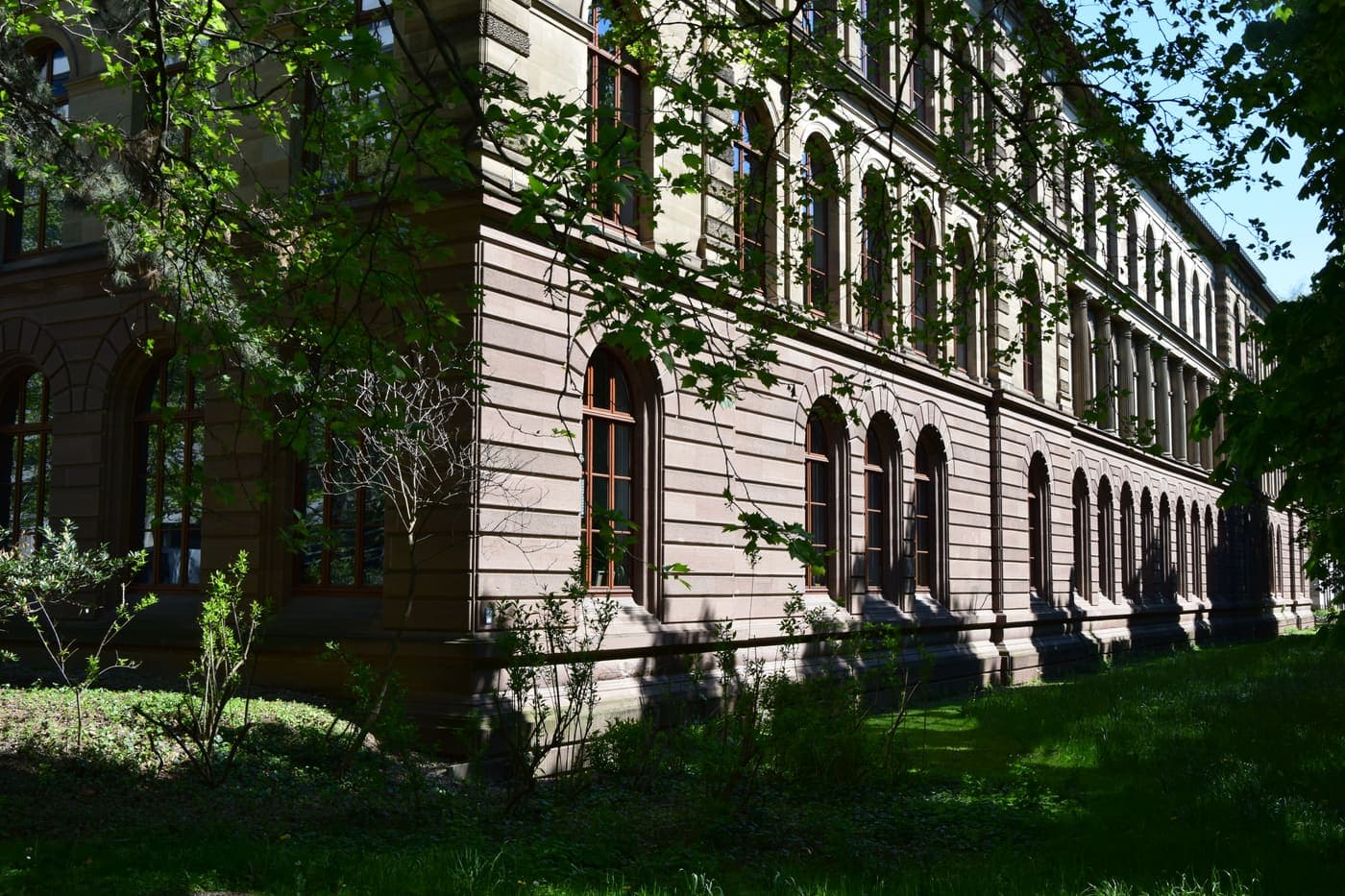
Photo credits: University of Stuttgart (Cyber Valley partner) by MSeses, CC BY-SA 4.0. Via Wikimedia Commons. All image credits
