
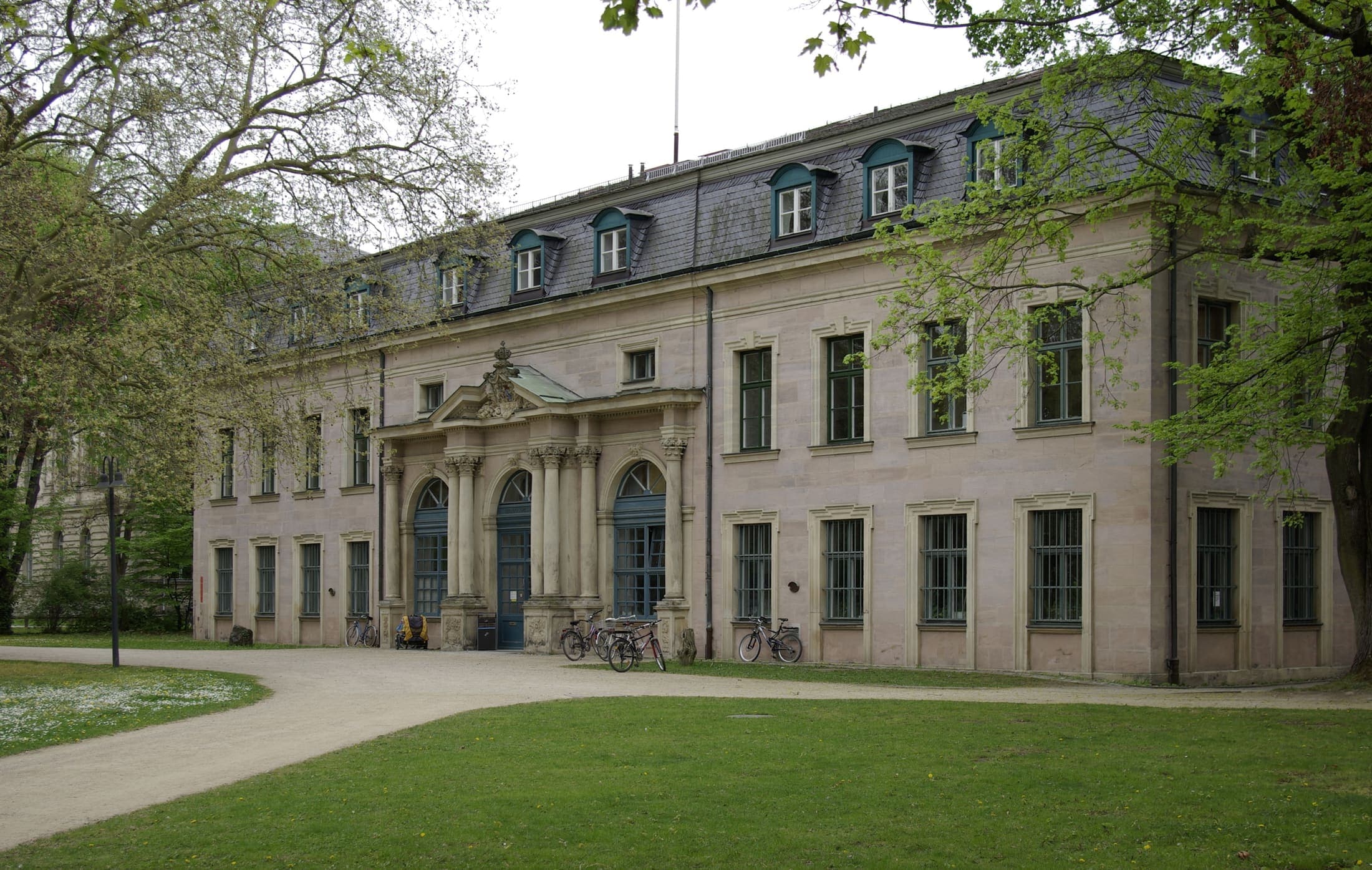
FAU Erlangen-Nürnberg (Friedrich-Alexander-Universität)
Quick Snapshot & Key Statistics
| Official Name | Friedrich-Alexander-Universität Erlangen-Nürnberg (FAU Erlangen-Nürnberg) |
| Institution Type | Public Comprehensive Research University |
| Established | 1743 (Founded by Frederick, Margrave of Brandenburg-Bayreuth) |
| Motto | Wissen in Bewegung ("Knowledge in Motion") |
| Total Enrollment | ~38,000+ Students (~5,200+ International Students from 130+ nations) |
| Academic Faculties | 5 Comprehensive Faculties | Over 260 Degree Programs |
| Locations | Erlangen, Nuremberg (Nürnberg), and Fürth, Bavaria, Germany |
| Institutional Affiliations | EELISA European University Alliance, Medical Valley EMN, ZOLLHOF Tech Incubator |
| Global Rankings | Top 150–200 Worldwide (THE) | Ranked #1 in Germany for Innovation (Reuters) |
| Tuition Fees (Regular Degrees) | €0 / year (Tuition-Free for standard Bachelor's/Master's degrees for all EU & non-EU students) |
| Semester Contribution | ~€82 per semester (Student Services fee; public transit ticket purchased separately) |
About FAU Erlangen-Nürnberg
Founded in 1743, Friedrich-Alexander-Universität Erlangen-Nürnberg (FAU) is one of Germany's largest and most innovative research universities. Spanning the neighbouring Bavarian cities of Erlangen, Nuremberg, and Fürth, FAU is widely recognised for its high research output and strong integration with industry.
FAU stands out for its interdisciplinary research strengths across Engineering, Artificial Intelligence, Materials Science, Medical Technology, Immunology, and Business Economics. It serves as an anchor institution for Medical Valley EMN (a top-tier healthcare cluster) and collaborates directly with neighbouring corporate research hubs, including Siemens, Schaeffler, adidas, Puma, Continental, and the Fraunhofer Institutes (IIS and IISB).
Why Choose FAU Erlangen-Nürnberg?
- One of Germany's largest public universities
- Strong international reputation
- 5 faculties and over 270 degree programmes
- Excellent research facilities
- Affordable public university education
- Numerous English-taught Master's programmes
- Strong collaborations with global companies
- Outstanding internship opportunities
- Excellent graduate employability
- International student-friendly environment
Location & Campus Structure of FAU Erlangen-Nürnberg
FAU does not have a single isolated campus; its facilities are distributed across three cities in the European Metropolitan Region of Nuremberg:
- Erlangen City Centre Campus: Centred around the historic Baroque Palace (Schloss Erlangen) and Schlossgarten. Houses University Administration, Humanities, Social Sciences, Law, and Theology.
- Southern Campus Erlangen (Südcampus): A sprawling high-tech STEM hub housing the Faculties of Engineering and Sciences, the Department of Artificial Intelligence in Biomedical Engineering (AIBE), and Fraunhofer Institutes.
- Nuremberg Campus (WiSo Nürnberg): Located in central Nuremberg, housing the famous School of Business, Economics and Society (Fachbereich Wirtschaftswissenschaften).
- Medical Campus (Erlangen): Integrated around the University Hospital Erlangen (Uniklinikum Erlangen), hosting clinical research centres and translational medicine suites.
Popular & Unique Degree Programs
Friedrich-Alexander-Universität Erlangen-Nürnberg (FAU) is organized into 5 main academic faculties—the Faculty of Humanities, Social Sciences, and Theology; the Faculty of Business, Economics, and Law encompassing the School of Law in Erlangen and the WiSo School of Business, Economics and Society in Nuremberg; the Faculty of Medicine integrated with the University Hospital Erlangen; the Faculty of Sciences; and the Faculty of Engineering—which collectively offer over 260 degree programs spanning Bachelor's, Master's, and State Examination qualifications.
Top English-Taught Master's Programs
- M.Sc. Artificial Intelligence: Advanced machine learning, computer vision, robotics, and natural language processing.
- M.Sc. Advanced Materials and Processes (MAP): Elite interdisciplinary program combining materials science, chemical engineering, and nanotechnology.
- M.Sc. Medical Engineering: Top European medical technology program bridging bio-signal processing, medical imaging, and prosthetics.
- M.Sc. Computational Engineering: Numerical simulation, high-performance computing, and computational fluid dynamics.
- M.Sc. Data Science: Statistical modelling, big data analytics, and machine learning architectures.
- M.Sc. Clean Energy Processes: Sustainable energy conversion, hydrogen technology, and green chemical engineering.
Top German-Taught Degree Programs
- Human Medicine & Dentistry (Staatsexamen): Competitive clinical training operated at University Hospital Erlangen (Uniklinikum Erlangen).
- Law (Rechtswissenschaft - Staatsexamen): Prestigious law school based in Erlangen.
- B.Sc. / M.Sc. Industrial Engineering and Management (Wirtschaftsingenieurwesen): High-demand double qualification merging engineering with business management at the Nuremberg campus.
- B.Sc. / M.Sc. Business Administration (BWL - WiSo Nürnberg): One of Germany's largest business schools with strong corporate links across Franconia.
- B.Sc. / M.Sc. Mechatronics & Mechanical Engineering: Traditional engineering degrees featuring state-of-the-art automotive and robotics testing halls.
Language Requirements (English & German)
Language prerequisites depend on the primary medium of instruction for your chosen program at FAU.
German Language Requirements (German-Taught Programs)
For degree programs taught in German, including standard Bachelor's degrees and State Examination programs like Medicine, Dentistry, and Law, non-native applicants must prove C1 CEFR German proficiency:
- DSH: DSH-2 or DSH-3.
- TestDaF: Minimum level of 4x4 (TDN 4 in all 4 examination sections).
- telc: telc Deutsch C1 Hochschule.
- Goethe-Zertifikat: Goethe-Zertifikat C2 (or C1 with high subscores).
English Language Requirements (English-Taught Programs)
For international Bachelor's and Master's degree programs taught in English, applicants must submit proof of B2 or C1 CEFR English proficiency:
| IELTS Academic | Overall 6.5 or 7.0 (program-dependent) |
| TOEFL iBT | 85 to 95 points or higher |
| Cambridge English | C1 Advanced (CAE) or C2 Proficiency (CPE) |
| PTE Academic | 62 to 65 points or higher |
Fee Structure at FAU Erlangen-Nürnberg
Standard Bachelor's and Master's degree programs at FAU do NOT charge tuition fees for EU or non-EU international students.
Bachelor's Programmes
- Tuition Fee: No tuition fees
- Semester Contribution: Approximately €82 per semester
Master's Programmes
- Tuition Fee: No tuition fees
- Semester Contribution: Approximately €82 per semester
- Note: Students pay only the semester contribution, making FAU Erlangen-Nürnberg one of Germany's most affordable public universities.
Mandatory Administrative & Living Costs
- Semester Contribution (Semesterbeitrag): ~€82 per semester (paid twice annually for re-registration).
- Blocked Account (Sperrkonto) for Visa: Non-EU international students must deposit €11,904 per year into an official Blocked Account to draw €992 per month for living costs.
- Monthly Living Costs in Erlangen/Nuremberg: Living costs in the region are moderate compared to Munich or Frankfurt. On average, students spend between €850 and €1,100 per month.
Research & Industry Partnerships
FAU Erlangen-Nürnberg collaborates with:
- Siemens
- Adidas
- Bosch
- Audi
- Schaeffler
- Fraunhofer Society
- Max Planck Society
- Siemens Healthineers
- DATEV
- Infineon Technologies
These collaborations provide students with internships, research projects, innovation programmes, and excellent graduate employment prospects.
Let's plan your path to studying at FAU Erlangen-Nürnberg
From matching your profile to the right faculty to preparing a compelling application, our counsellors guide every step of your journey.
Frequently Asked Questions (FAQs)
The Erlangen-Nuremberg industrial region is one of Germany's strongest economic zones, hosting global headquarters and R&D centres for Siemens, Siemens Healthineers, adidas, Puma, Schaeffler, Continental, and DATEV. Enrolled FAU students can work up to 20 hours per week during term time as Werkstudent. Engineering, IT, data science, and business roles pay competitive wages (€15 to €23+ per hour), serving as a direct entry point into full-time post-graduate careers.
Medical Valley European Metropolitan Region Nuremberg (EMN) is an internationally leading healthcare technology cluster centred in Erlangen. FAU is its primary academic driver, collaborating directly with Siemens Healthineers and local research institutes on medical imaging, health AI, and digital diagnostics.
Founded under Bavaria's High-Tech Agenda, AIBE is a dedicated department within FAU's Faculty of Engineering. It bridges computer science, machine learning, robotics, and clinical medicine to develop AI-driven diagnostic tools and bio-sensor technology.
ZOLLHOF is one of Germany's fastest-growing tech incubators, located in Nuremberg. Co-founded with FAU and corporate partners, it provides student entrepreneurs with seed funding, office space, legal advice, and direct connections to corporate venture funds.
Siemens and Siemens Healthineers maintain their historical ties in Erlangen. Siemens operates major R&D hubs directly adjacent to FAU's Southern Campus, offering sponsored Master's theses, working student positions, joint research labs, and doctoral scholarships.
EELISA (European Engineering Learning Innovation and Science Alliance) is an official European University alliance co-led by FAU alongside institutions like UPMA Madrid, ENPC Paris, and ITU Istanbul, offering international mobility modules and joint engineering credentials.
WiSo Nürnberg is the School of Business, Economics and Society located in central Nuremberg. It is one of Germany's premier business schools, hosting degrees in business administration, economics, industrial engineering, and socio-economics.
The High-Tech Agenda is a multi-billion-euro funding initiative by the Bavarian state government. It has funded dozens of new professorships, advanced supercomputing infrastructure, and new research laboratories at FAU in AI, clean energy, and quantum technology.
Frequent regional train (S-Bahn) and bus links connect Erlangen and Nuremberg in under 20 minutes. Students can purchase a discounted regional or nationwide transit pass (Deutschlandticket) to travel seamlessly between campus hubs.
This joint interdisciplinary research centre brings together FAU, the University Hospital Erlangen, and the Max Planck Institute for the Science of Light to investigate physical processes in living biological cells and disease mechanisms.
Campo is FAU's central online university management portal. Students use Campo to manage course registrations, download official enrollment certificates, check exam grades, and re-register for upcoming semesters.
Studierendenwerk Erlangen-Nürnberg operates student residence halls across Erlangen and Nuremberg. Rent ranges from €300 to €500 per month. Due to high demand in Erlangen, incoming international students are encouraged to apply for housing immediately upon receiving their admission offer.
Choose FAU Erlangen-Nürnberg if you want to study at one of Germany's top public research universities with affordable education, excellent engineering and AI programmes, strong industry partnerships, and outstanding career opportunities. Its campuses in Erlangen and Nuremberg provide students with direct access to some of Germany's leading technology, healthcare, and business sectors.
Explore Other Universities in Germany
Photo credits: Munich New Town Hall, Marienplatz by Dietmar Rabich, CC BY-SA 4.0. Via Wikimedia Commons. All image credits
